
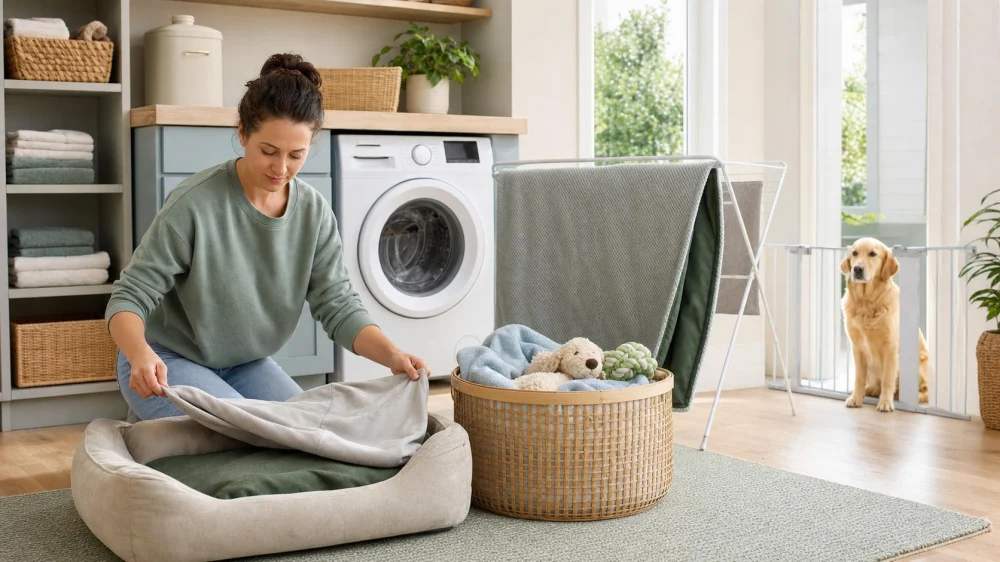
Pet Bedding Laundry: Wash, Dry, and Replace Safely
On this page
- Quick answer
- Sort what can actually be cleaned
- Choose a practical schedule
- Prepare bedding without spreading debris
- Follow the correct wash method
- Dry every layer completely
- Clean plush and rope toys
- Know when disinfection is different
- Adjust when a pet is sick
- Know when to replace an item
- Protect people and other pets
- Veterinary and product limits
- Laundry checklist
- Frequently asked questions
- Evidence and sources
- Next steps
Quick answer
Check each pet bed, blanket, cover, plush toy, and rope toy for a care label. Remove loose hair and debris without shaking it through the home, wash with detergent on the appropriate cycle and temperature, and dry every layer completely before returning it to the pet.
The CDC suggests cleaning pet beds, blankets, and habitats about weekly and toys about monthly as a general example, with more frequent cleaning when items are dirty, a pet is sick, or a household member is at higher risk from germs. Product instructions and veterinary guidance take priority.
Sort what can actually be cleaned
Make a simple inventory:
- removable bed covers;
- inner foam or fiber inserts;
- crate pads and blankets;
- pet clothing and towels;
- plush, rope, and fabric toys;
- heated or cooling beds;
- items that contact urine, stool, vomit, blood, or wound drainage.
Read every sewn label and keep manufacturer instructions. “Machine-washable cover” does not mean the foam insert can enter the washer. Electronics, heat pads, gel inserts, cedar fill, orthopedic foam, and waterproof membranes may need different handling.
Photograph complicated covers before disassembly and inspect hidden zippers, hook-and-loop closures, and inner liners. Close fasteners as directed so they do not snag other items.

Choose a practical schedule
A weekly bedding check is easy to attach to household laundry. Wash sooner when fabric is visibly dirty, wet, oily, strongly odorous, covered with hair, or used by a pet with an accident.
Season, shedding, skin conditions, outdoor activity, number of animals, and sleeping habits affect the schedule. A dog that swims daily or a cat recovering from diarrhea may need more frequent changes than an indoor healthy pet.
Keep a second washable cover or blanket so the pet has a clean resting place while laundry dries. Do not return a damp bed because the pet is waiting.
Prepare bedding without spreading debris
Keep pets and children away from the sorting area. Wear gloves when handling urine, stool, vomit, blood, wound drainage, or veterinary-treatment residue, then wash hands.
Remove loose hair outdoors where permitted or use a vacuum with an appropriate attachment. Do not vigorously shake contaminated bedding indoors. Pick up solid waste with disposable material and follow local disposal rules.
Separate items that may contain a sharp object, damaged battery, heating wire, broken zipper, splinter, medication patch, or chemical. Do not place them in the washer until the hazard is resolved.
Pre-treat stains only with a product compatible with the material and safe when used as labeled around pets. Avoid essential-oil mixtures or unverified “natural” disinfectants.
Follow the correct wash method
For machine-washable soft items, use detergent and the cycle and water temperature allowed by the care label. CDC guidance notes that fragrance-free and dye-free detergent may be a better choice for pets with sensitive skin.
Do not overload the washer. Large beds can become unbalanced, retain detergent, or damage a household machine. A commercial machine may be appropriate if its policy allows pet bedding and the item label permits it.
Rinse thoroughly. Extra detergent does not make an item safer and residue can irritate skin. Do not mix bleach with ammonia, vinegar, acids, or another cleaner.
Clean visible debris from the washer after the load. Follow the appliance manufacturer’s maintenance instructions rather than adding an improvised chemical cycle.
Dry every layer completely
Use the dryer setting allowed by the label or air-dry the item in a clean, well-ventilated area. Turn thick beds and open folds so the center dries. Foam may feel dry outside while holding moisture inside.
CDC guidance for items without specific instructions says a washing machine and dryer can clean soft pet supplies; a highest-heat 30-minute dryer step is described for disinfection. That approach is not suitable for every textile, foam, membrane, or electronic item. Follow the product label and veterinary directions.
Before reuse, smell and press the deepest layers. Return the bed only when cool and completely dry. High dryer heat can melt fill, damage waterproof coatings, or create a fire risk when prohibited.
Clean plush and rope toys
Inspect toys before washing. Remove toys with exposed stuffing, loose eyes, torn seams, frayed ropes, cracked squeakers, sharp parts, or pieces small enough to swallow.
Wash only as the manufacturer directs. A mesh laundry bag can contain compatible small items but does not make a non-washable toy safe for a machine. Dry internal stuffing completely.
CDC says non-refillable catnip toys and other items that cannot be cleaned should be discarded when dirty. Replace a favorite toy with a safer similar option rather than repeatedly returning a contaminated or damaged object.
Supervise play after washing because shrinkage or loosened parts can change the toy.
Know when disinfection is different
Cleaning removes dirt and many germs with soap or detergent. Disinfection uses a product or process to kill more germs. Routine cleaning is often enough for ordinary pet items; disinfection may be added after contact with waste, during illness, or for higher-risk households.
Only use a disinfectant according to its label, including dilution, surface compatibility, contact time, ventilation, rinsing, and drying. Keep pets away during use and store products securely.
Never spray or wipe a pet with an environmental disinfectant. Do not assume vinegar disinfects all relevant germs; CDC notes evidence is insufficient for it as a general cleaning or disinfecting substitute.
Adjust when a pet is sick
Ask the veterinarian which items to clean, which product or temperature to use, how often, and how long to continue. Different parasites, fungi, bacteria, and viruses require different approaches.
For Giardia treatment, CDC advises regular cleaning and disinfection of toys, bowls, bedding, crates, litter boxes, and floors, with daily cleaning when possible during medication and for a few days afterward. That example should not be generalized to every condition.
Keep the sick pet’s items separate when instructed. Wash hands after handling supplies and before preparing food. Tell the veterinarian about other pets and people in the home, especially anyone pregnant, very young, older, or immunocompromised.
Know when to replace an item
Replace bedding or toys when they cannot be cleaned and dried, retain a strong odor after correct washing, have recurring mold-like growth, expose foam or stuffing, contain broken electrical parts, no longer support the pet, or create an ingestion or entanglement hazard.
Do not donate an item that is contaminated, damaged, or under a veterinary isolation plan. Follow local waste instructions for electronic, heated, gel, or chemically treated products.
Choose replacement beds with removable covers, clear care labels, accessible seams, and a size suited to the animal. Washability is a practical safety feature.
Protect people and other pets
Wash hands with soap and running water after handling pet bedding, waste, habitats, or dirty equipment. CDC notes animals can carry germs even when they look clean and healthy.
Keep dirty bedding away from kitchen counters and food preparation. If cleaning by hand, use a dedicated tub, laundry sink, or bathtub when advised, and clean that area afterward.
Do not let another pet take the temporary laundry pile or chew detergent packaging. Store clean items dry and away from pests.
Veterinary and product limits
This article provides general hygiene information, not veterinary diagnosis or treatment. Skin disease, parasites, diarrhea, incontinence, wound drainage, recurring odor, or sudden bed avoidance may require veterinary evaluation.
Follow the item, appliance, detergent, and disinfectant labels. Ask the veterinarian for disease-specific instructions, particularly when a pet or household member is at higher risk.
Laundry checklist
- Read labels and separate covers, inserts, and electronics.
- Remove hair and solid debris without shaking indoors.
- Wear gloves for body-fluid contamination and wash hands.
- Use the approved detergent, cycle, and temperature.
- Rinse well and avoid incompatible chemicals.
- Dry every layer completely.
- Inspect seams, stuffing, fasteners, and toy parts.
- Follow veterinary directions during illness.
Frequently asked questions
Can pet bedding go in the washer with human laundry?
CDC says pet items can be washed with clothes, but item labels, contamination, household risk, and veterinary instructions may call for separation.
How often should I wash a pet bed?
CDC gives weekly as a general example. Wash sooner for visible soil, moisture, odor, illness, or veterinary instruction.
Can I use scented detergent?
Follow the label and your veterinarian’s advice. Fragrance-free and dye-free detergent may be preferable for sensitive skin.
What if the foam cannot be washed?
Follow the manufacturer’s spot-cleaning method. Replace it if it cannot be adequately cleaned, fully dried, or safely reused.
Evidence and sources
- CDC: Cleaning and disinfecting pet supplies
- CDC: Hygiene practices around animals
- CDC: Giardia cleaning guidance
Next steps
Check every bed and soft toy for a care label, damage, and removable parts. Set a weekly bedding reminder, create a clean backup resting place, and wash one complete set.
If the pet is sick or the item touched body fluids, pause and ask the veterinarian for condition-specific cleaning and isolation instructions.





 Living Reef Orlando4.0 (404 reviews)
 Wexler Elaine DVM4.0 (13 reviews)
 Petco4.0 (801 reviews)
 Anasazi Animal Clinic4.0 (205 reviews)
 Foley James P DVM5.0 (3 reviews)
 The Cat Doctor4.0 (125 reviews)
 How to Create a Safe Outdoor Enclosure for Your Cat
 How to Choose the Right Collar for a Growing Kitten: A Complete Guide
 The Top 10 Most Instagram-Famous Pets and Their Stories
 How to Introduce a New Baby to Your Resident Cat Safely
 How to Tell if Your Kitten is Too Skinny: Signs and Solutions
 Understanding Kitten Neutering and Spaying: Best Age and Benefits