
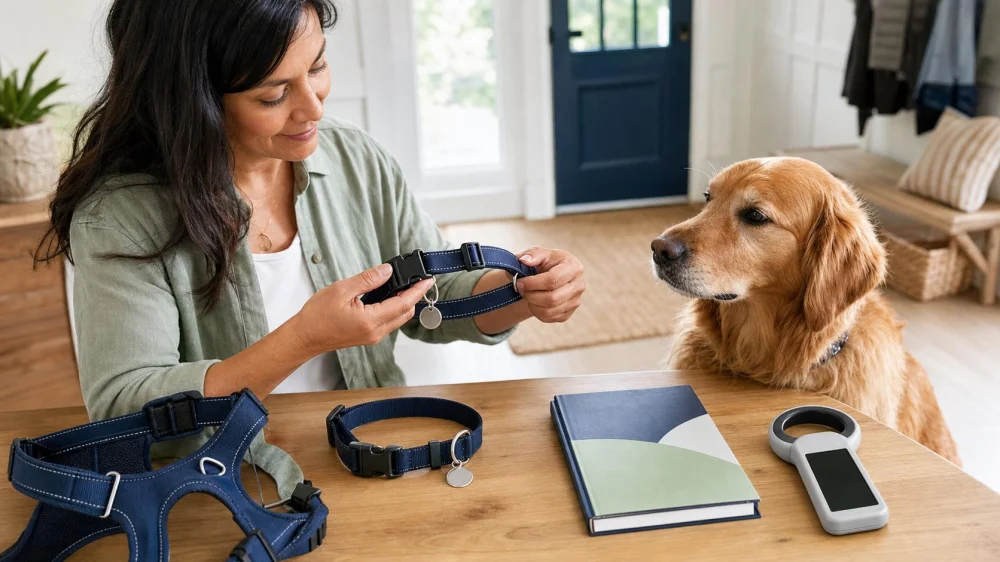
Pet Collar and ID Tag Check: Fit, Wear, and Backup
On this page
- Quick answer
- Use visible ID and a registered microchip
- Check collar fit on the individual pet
- Inspect wear and hardware
- Make the tag useful
- Manage noise without hiding identity
- Match the collar to species and lifestyle
- Separate ID needs from leash control
- Plan for home, crate, and play
- Update ID for travel and emergencies
- Know what to do if the pet gets lost
- Veterinary and safety limits
- Monthly collar check
- Frequently asked questions
- Evidence and sources
- Next steps
Quick answer
Once a month, confirm that the collar is the right type and fit for the individual pet, the material is intact, the buckle and adjustment points hold, tags are readable, and the phone number reaches you. Recheck after grooming, weight change, growth, skin irritation, or a new harness.
Visible identification and a registered microchip serve different purposes. The AVMA notes that an up-to-date collar tag can help someone identify a found pet quickly, while a microchip can provide permanent backup if the collar is lost or removed. Keep both records current where appropriate.

Vetco Total Care Animal Hospital
StoweMontgomery CountyPennsylvania
240 Upland Square Dr, Stowe, PA 19464, USA
Use visible ID and a registered microchip
A collar tag can show a finder how to contact you without special equipment. A microchip is read by a scanner and links to registration information; it is not a GPS tracker.
Ask a veterinarian whether microchipping is appropriate, have the chip scanned during routine care as advised, register it with the correct database, and update phone, email, address, alternate contact, and veterinarian information after a change.
Check local license and rabies-tag requirements. Some jurisdictions or situations require tags, while noise or snag risk may affect how they are attached. Do not remove a legally required tag without an approved alternative.
Check collar fit on the individual pet
There is no universal finger rule that fits every species, breed, coat, collar design, age, and medical condition. Follow the manufacturer and veterinarian’s guidance. The collar should stay in the intended position without restricting breathing, swallowing, movement, or normal skin condition.
Check fit while the pet is standing calmly. Look around the full neck, under dense fur, behind the ears, and beneath hardware. Watch for redness, hair loss, odor, moisture, swelling, scabs, pressure marks, or rubbing.
Puppies and kittens grow quickly. Long-coated pets can change apparent fit after grooming, and weight gain or loss can alter pressure. Recheck more often during change.
Do not tighten a collar to stop escape without identifying why it slips. A different design, harness, secure environment, behavior plan, or veterinary advice may be needed.
Inspect wear and hardware
Run your fingers along both sides of the collar. Bend it gently and inspect:
- frayed fabric or cracked leather;
- stretched holes and slipping adjusters;
- rust, sharp edges, or bent rings;
- cracked plastic buckles;
- loose rivets, stitching, or reflective strips;
- sand, salt, mud, or hair trapped under hardware;
- chewed sections and tooth damage.
Test the closure according to manufacturer instructions while the collar is off the pet. Replace a questionable collar instead of adding tape, glue, a household clip, or an improvised ring.
After swimming or rain, clean and dry the collar as directed. Saltwater and moisture can affect metal, fabric, skin, and tag readability.
Make the tag useful
Use contact information that a finder can act on quickly. A mobile number is often useful; an alternate number can provide backup. Decide with your veterinarian and local requirements whether to include the pet’s name, address, medical alert, license, rabies tag, or microchip registry note.
Read the tag in ordinary light. Engraving and printed inserts wear down. Check both sides and ensure information is not hidden under stacked tags.
Call the number from another phone. Check voicemail capacity and whether an unfamiliar caller can leave a message. Update temporary travel contact separately when needed.
Do not place a full medical record or sensitive personal details on an exposed tag. A concise medical alert can direct a finder to call you or the veterinarian.
Manage noise without hiding identity
Multiple metal tags can be noisy. Options may include a secure tag silencer, a slide-on tag compatible with the collar, or an embroidered contact panel, but each has tradeoffs in visibility, durability, and local compliance.
Ensure a silencer does not cover required information, trap moisture, create a chewable part, or prevent tags from hanging correctly. Inspect slide-on hardware for sharp edges and fit.
Do not remove all identification merely because tags jingle. Ask a veterinarian or local licensing authority about safer compliant arrangements.
Match the collar to species and lifestyle
Cats, dogs, rabbits, ferrets, birds, reptiles, and other pets have different anatomy and risks. Do not adapt a dog collar to another species without professional guidance.
For cats, ask the veterinarian about an appropriate breakaway design and correct fit, particularly for outdoor access. A breakaway collar can reduce some snag hazards but may be lost, which makes microchip backup important.
Working, sporting, brachycephalic, very small, elderly, disabled, or medically complex dogs may need specific equipment. A collar that works for visible ID may not be suitable for leash pressure or restraint.
Growing pets need frequent checks. Senior pets may develop fragile skin, lumps, arthritis, or sensitivity that changes handling.
Separate ID needs from leash control
An ID collar is not automatically the right leash attachment. Pulling, coughing, airway disease, neck pain, escape behavior, and body shape can make a fitted harness or other veterinarian-approved setup preferable.
Ask a veterinarian or qualified trainer how to attach the leash and prevent escape. Check the harness independently for chafing, strap twist, buckle wear, and correct adjustment.
Do not attach a long line, tie-out, seat belt, or heavy equipment to a collar unless the product and professional guidance explicitly support it. Never leave a tethered pet unattended.
Plan for home, crate, and play
Collars can catch on crate wires, vents, furniture, branches, fences, heating grates, another pet’s jaw, or play equipment. Whether a pet should wear a collar while crated or unsupervised depends on the animal, environment, collar design, and veterinary or trainer guidance.
Inspect the home at collar height. Separate pets if rough play involves grabbing collars. Never lift, restrain, or drag a pet by the collar.
If the collar is removed at home for safety, use door and gate controls, keep the collar immediately accessible, and rely on a registered microchip as backup. Every caregiver should know the household plan.
Update ID for travel and emergencies
Before travel, verify the destination address, primary mobile number, alternate contact, veterinary contact, license rules, and microchip registration. Add a temporary tag or waterproof insert if appropriate without covering permanent information.
Photograph the pet from several angles, including distinctive markings, and save the microchip number separately. Carry a recent veterinary record as required, but do not hang confidential paperwork from the collar.
Check collar and harness fit after long travel, grooming, and exposure to water or sand. Confirm that the carrier also has external identification.
Know what to do if the pet gets lost
Start with local animal control, shelters, veterinary clinics, the microchip registry, and verified local lost-pet resources. Give a clear recent photo, location, time, contact information, and a safe handling warning if needed.
Report the microchip as lost through the registry and verify your contact record. Beware of callers demanding payment or verification codes before returning a pet. Do not meet an unknown person alone in an unsafe location.
Once reunited, have the pet checked for injury when appropriate, then determine how the escape and equipment failure occurred before normal outings resume.
Veterinary and safety limits
This article is general information. Collar type, fit, wear schedule, leash attachment, species suitability, skin problems, airway disease, mobility, and behavior require individual guidance.
Remove pressure and seek urgent veterinary care for breathing difficulty, collapse, severe swelling, choking, major neck trauma, or a collar embedded in skin. Do not cut near the pet’s skin without safe professional help.
Monthly collar check
- Correct type and fit for the pet
- No redness, hair loss, moisture, or pressure marks
- Buckle, adjuster, stitching, and rings intact
- Tag readable and phone number tested
- License and rabies requirements current
- Microchip scanned and registration updated as advised
- Harness and leash attachment checked separately
- Home, crate, play, and travel plan reviewed
Frequently asked questions
Does a microchip replace an ID tag?
No. AVMA guidance treats visible, current identification and a registered microchip as complementary layers.
How tight should a pet collar be?
Use manufacturer and veterinary guidance for the individual animal and design. It should not restrict breathing, swallowing, movement, or skin health.
Should a pet wear a collar in a crate?
Snag risk varies by crate, collar, animal, and supervision. Ask the veterinarian or qualified trainer and use secure environmental controls.
What information belongs on the tag?
Use a current contact number and comply with local license or rabies-tag rules. Add only concise information useful to a finder.
Evidence and sources
Next steps
Remove the collar while the pet is safely contained and inspect every surface and part. Verify the tag by calling its number, then check the microchip registry record.
If fit, skin, escape risk, or leash attachment is uncertain, pause equipment changes and ask the veterinarian or a qualified trainer for an individual plan.





 Living Reef Orlando4.0 (404 reviews)
 Wexler Elaine DVM4.0 (13 reviews)
 Petco4.0 (801 reviews)
 Anasazi Animal Clinic4.0 (205 reviews)
 Foley James P DVM5.0 (3 reviews)
 The Cat Doctor4.0 (125 reviews)
 How to Create a Safe Outdoor Enclosure for Your Cat
 How to Choose the Right Collar for a Growing Kitten: A Complete Guide
 The Top 10 Most Instagram-Famous Pets and Their Stories
 How to Introduce a New Baby to Your Resident Cat Safely
 How to Tell if Your Kitten is Too Skinny: Signs and Solutions
 Understanding Kitten Neutering and Spaying: Best Age and Benefits