
How to Build a Practical Pet Emergency Kit for Home and Travel
On this page
Quick answer
A practical pet emergency kit should cover safe transport, identification, water, food, basic wound protection, sanitation, light, and access to veterinary information for at least a short disruption. Keep supplies in a clearly marked, portable bag, tailor them to each animal, and review expiration dates and contact details every six months. The kit supports evacuation and first response; it does not replace veterinary care.
A pet emergency kit is a portable collection of supplies and records that helps an owner protect, move, identify, and care for an animal during an evacuation, power outage, severe-weather event, vehicle delay, or sudden trip to a veterinary clinic.

Northern Regional Veterinary Hospital
2611 W Northern Ave, Phoenix, AZ 85051, USA
Core supplies for every pet emergency kit
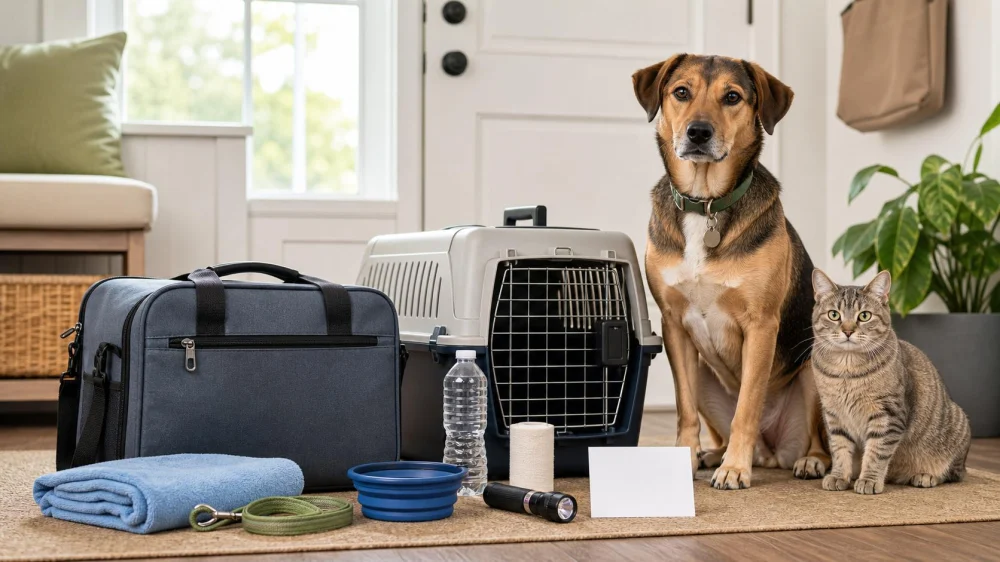
Start with items that solve the most common problems: moving a frightened animal, providing safe water and food, controlling minor contamination, and giving a veterinarian accurate information. Store everything in a water-resistant bag that one adult can carry.
- Secure transport: a correctly sized carrier or crate, sturdy leash or harness, and a spare slip lead when appropriate.
- Identification: current photos of each pet, owner contact details, microchip number if available, and a backup contact outside the household.
- Water and feeding: sealed drinking water, collapsible bowls, a manual can opener if needed, and a short supply of the pet’s usual food.
- Basic protection: disposable gloves, gauze pads, non-stick dressings, rolled gauze, self-adhering bandage, blunt-tip scissors, and clean towels.
- Cleaning and sanitation: waste bags, litter and a compact litter tray for cats, paper towels, and pet-safe cleaning supplies kept in sealed containers.
- Visibility and power: a flashlight, spare batteries, and a phone power bank checked on a regular schedule.
- Records: vaccination information, medication list, health conditions, veterinarian details, and nearby emergency-clinic contacts.
Choose compact supplies that are easy to inspect. A crowded bag is not automatically a useful bag; every item should have a clear purpose and be safe for the animals in your household.

Add items for your individual pet
The core list is only a starting point. Age, species, size, health, behavior, climate, and travel habits determine what belongs in the final kit.
For dogs
Pack a familiar leash and well-fitted harness, paw protection if local surfaces may become very hot or covered with debris, and a lightweight muzzle only if the dog has been positively trained to wear it. A muzzle is not suitable for a dog that is vomiting, struggling to breathe, or likely to overheat.
For cats
Keep a rigid or reinforced carrier accessible rather than stored behind heavy boxes. Include a small litter setup, a familiar cloth, and a carrier cover that can reduce visual stress while preserving airflow. Practice calm carrier entry before an emergency.
For pets with ongoing medical needs
Ask the prescribing veterinarian how to store medicines, how much backup supply is appropriate, and what to do if refrigeration or a scheduled dose is disrupted. Keep medicines in original labeled containers. Never add human pain relievers or unapproved sedatives “just in case”; many can be dangerous to animals.
Home kit versus travel kit
A home kit is best for sheltering in place or evacuating from the house. It can hold more water, food, bedding, cleaning supplies, and duplicate records. A travel kit is best for routine car trips and unexpected delays, so it should be smaller, secured against movement, and protected from temperature extremes.
A car kit is not ideal for long-term storage of food, medicine, batteries, or bottled water when the vehicle experiences intense heat or freezing conditions. Carry temperature-sensitive items from the home at departure, following product or veterinary storage guidance.
When choosing between one large kit and two smaller kits, use this decision rule: keep the essential transport and identification items with the pet’s carrier, then maintain a portable home supply bag and a compact travel module. This reduces the chance that every useful item is in the wrong location.
A simple build-and-maintain checklist
- List every pet. Record species, weight, carrier size, diet, medication, behavior concerns, and daily essentials.
- Choose the container. Use a durable, portable bag or bin that closes securely and is easy to identify without relying on decorative labels.
- Pack the core supplies. Group water and food, first-response materials, sanitation items, and records in separate sealed pouches.
- Add individual needs. Include the correct harness, carrier, food, comfort item, and veterinary-approved medical supplies for each animal.
- Create paper and digital records. Keep paper copies in a waterproof sleeve and encrypted or access-controlled digital copies where the household can retrieve them.
- Test the plan. Confirm that the pet fits the carrier, the bag can be lifted, household members know its location, and transport equipment works.
- Set a six-month reminder. Rotate food and water, check batteries, update photos and contacts, inspect fabric and closures, and review medical instructions.
Also check the kit after any use, move, new diagnosis, change in diet, adoption, or change in household contact details.
Important limits and safety notes
This guidance is for general preparedness in the United States and may not cover every regional hazard, evacuation rule, airline requirement, or animal species. Owners of birds, reptiles, small mammals, livestock, and exotic pets should obtain species-specific transport, temperature, feeding, and containment guidance from an appropriate veterinarian or local emergency authority.
Do not use a kit to delay urgent care. Contact a veterinarian or emergency clinic promptly for breathing difficulty, collapse, uncontrolled bleeding, seizures, suspected poisoning, severe trauma, heat illness, repeated vomiting, inability to urinate, or rapidly worsening behavior. Call ahead when possible so the clinic can advise safe transport.
First-aid materials are useful only when the owner knows their limits. Tight bandaging, induced vomiting, unapproved medicines, and forced feeding can cause harm. A pet first-aid course and a veterinarian-approved household plan are more valuable than adding unfamiliar tools.
Sources and evidence notes
The priorities in this checklist reflect broad emergency-preparedness practice: maintain identification and health records, provide safe containment, keep basic food and water, plan for sanitation, and know how to reach professional help. Exact quantities and storage periods depend on the pet, household plan, local hazards, and current guidance from veterinarians and public emergency agencies. Verify your plan with your veterinarian and local emergency-management information rather than relying on a generic list alone.
Frequently asked questions
How much food and water should a pet emergency kit contain?
Choose an amount your household can safely store, rotate, and carry, then compare it with current local emergency guidance and your veterinarian’s advice. Needs vary by species, body size, diet, weather, medical condition, and evacuation plan. Keep the usual food when possible to reduce digestive disruption.
Should I put hydrogen peroxide or human medicine in the kit?
Do not include or give a drug solely because it appears on a general internet checklist. Human medicines and attempts to induce vomiting can be dangerous in some situations. Include only products your veterinarian has approved for your specific pet, with clear instructions.
Where should the kit be stored?
Keep it in a dry, accessible location near the carriers or the household’s exit route, but away from children and animals. Everyone responsible for the pets should know where it is. Avoid areas with severe heat, freezing, moisture, or pests.
How often should records and supplies be updated?
Review the kit about every six months and after any major change. Update contacts, photos, medical information, and feeding instructions; rotate dated supplies; recharge power banks; and inspect carriers, leashes, and fasteners.
Is one emergency kit enough for multiple pets?
One supply bag can work if it remains portable and contains clearly separated items for each pet. Every animal still needs suitable identification and safe containment. Large households may respond faster with labeled modules inside one main bag or with multiple coordinated kits.
Next steps
Begin with transport, identification, water, and veterinary contacts today. Add the remaining supplies in clearly grouped pouches, test whether you can move every pet safely, and schedule the first six-month review. Finally, ask your veterinarian which medical items and instructions are appropriate for each animal; a tailored plan is safer than an oversized generic kit.






 BluePearl Pet Hospital3.0 (657 reviews)
 Critters 'N Crawlies LLC5.0 (1 reviews)
 Walker Street Dog & Cat Hospital3.0 (23 reviews)
 Creative Aquariums of Tampa4.0 (163 reviews)
 Hollywood Feed4.0 (544 reviews)
 Petco4.0 (1142 reviews)
 How to Train Your Kitten to Use a Flushable Litter Box
 How to Train Your Kitten to Play Dead
 Why Does My Cat Bite Me Gently? Love Bites Explained
 The Best Diet for a Bengal Kitten's Wild Ancestry
 How to Stop a Kitten from Clawing at Window Screens
 Best Holiday Gifts for Dog and Cat Lovers | Gift Ideas for Pet Owners