
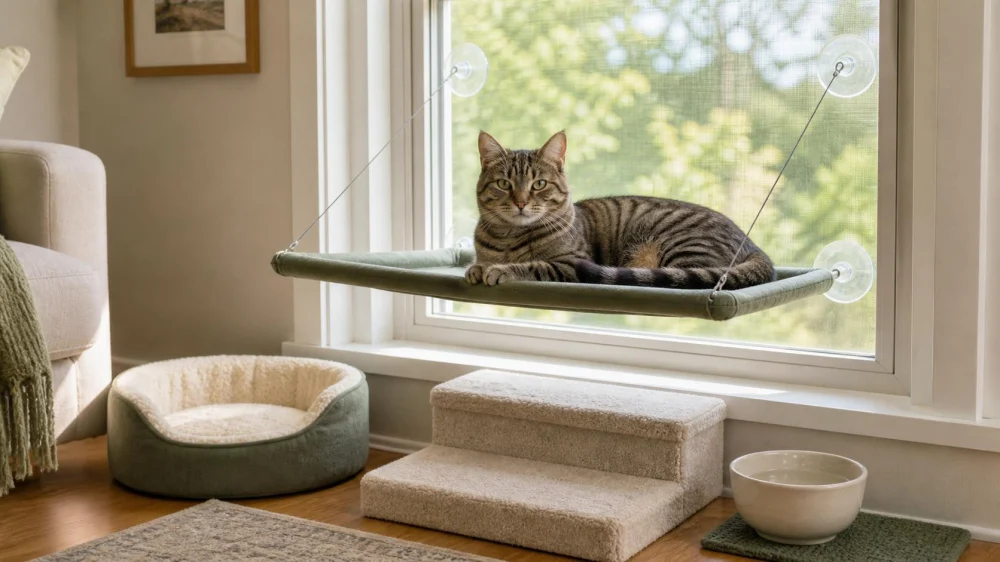
Cat Window Perch Safety: Check the Mount, Screen, and Sun
On this page
- Quick answer
- Choose the right perch type and size
- Inspect the window and screen
- Install the mount exactly as directed
- Load-test before the cat uses it
- Create a safe route up and down
- Manage sun, heat, and drafts
- Remove blind cords and nearby hazards
- Recheck and clean the perch
- Window-perch checklist
- Frequently asked questions
- Sources and evidence notes
- Conclusion and next steps
Quick answer
Choose a cat window perch rated above the cat’s weight and compatible with the exact glass, sill, or wall surface. Inspect the window frame, lock, and snug sturdy screen; secure blind cords; install every bracket, suction cup, cable, and fastener as directed; then load-test the empty perch gradually while supporting it. Provide a nonslip route up and down, shade and fresh water, and another resting place. Recheck the mount frequently and keep windows closed unless the screen is truly pet-secure.
This guide covers ordinary indoor cat perches in US homes. Follow the perch, window, screen, wall, and rental instructions. Ask a veterinarian about mobility, vision, neurologic, heat-tolerance, or recovery needs that may change whether an elevated perch is appropriate.

Monadnock Equine Veterinary Services
MarlboroughCheshire CountyNew Hampshire
464 Old Chesham Rd, Marlborough, NH 03455, USA
Choose the right perch type and size
Measure the cat’s body length and weight, the usable sill or glass area, the window opening, nearby wall structure, and landing space. Select a manufacturer-rated perch with enough lying area for the cat to turn and settle without overhanging an edge.
Common mounting styles include:
- sill-supported: brackets rest on or clamp to a suitable windowsill;
- suction-mounted: cups attach to compatible clean glass and may use support cables;
- wall-mounted: fasteners attach to the wall structure beside or below a window; and
- freestanding: a stable cat tree, bench, or furniture-style perch sits near the window.
Do not combine parts from unrelated products or exceed the stated weight, cat count, surface, or installation method. A larger cat or two cats can create dynamic loads when jumping that differ from quiet resting weight.

West Haven Animal Clinic
West HavenSouth Central Connecticut Planning RegionConnecticut
959 Campbell Ave, West Haven, CT 06516, USA
Inspect the window and screen
Close and lock the window during setup. Check the glass for cracks, the frame for looseness or rot, and the sill for moisture damage. Confirm the perch will not press against a screen, interfere with the lock, block an emergency exit, or prevent normal window operation.
An ordinary insect screen may pop out, tear, or detach under a cat’s weight. ASPCA and AVMA resources recommend snug, sturdy screens for open windows and warn that child window guards are not adequate cat protection. A perch should never invite the cat to lean on the screen.
Ask a qualified window professional or landlord before drilling, clamping, or adding a pet screen. Do not defeat a required window stop, fire-egress function, security device, or lease condition.
Install the mount exactly as directed
Read the current instructions and gather every supplied part before starting. Verify the model, weight limit, compatible surface, cleaning method, fastener type, cure or waiting time, and replacement-part guidance.
For suction cups, clean the glass and cups using only the method the manufacturer specifies; residue, texture, film, extreme temperature, damage, and incompatible cleaners can affect adhesion. Press and position each cup as directed, with cables untwisted and equally loaded.
For clamps or wall fasteners, confirm sill dimensions and wall structure. Drywall alone may not support a mount that requires a stud or anchor. If the instructions or structure are unclear, use a qualified installer or choose a stable freestanding option.
Load-test before the cat uses it
Keep the cat out of the room and close the window. Check that the bed platform is level, all hardware is seated, fabric sleeves are engaged, and no cable, bracket, or edge is damaged.
- Push gently in each direction while supporting the platform.
- Add a manufacturer-approved test load gradually, without exceeding the rating.
- Watch every mount point for sliding, lifting, flexing, or sound.
- Remove the load and recheck the position.
- Let the cat investigate under close supervision.
Do not use a child, another pet, or your own body as a test weight. Stop if a suction cup bubbles or slips, a sill bends, a fastener turns, glass flexes, or the platform tilts.
Create a safe route up and down
Place a stable nonslip step, bench, cat tree, or ramp so the cat can reach the perch without a long leap across furniture. Keep the launch and landing zones clear of glass objects, lamps, sharp corners, hot radiators, stoves, and hard clutter.
Older cats and cats with arthritis, vision loss, weakness, obesity, recent surgery, or limb problems may need wider steps, lower height, carpeted traction, and shorter gaps. Cornell’s senior-cat guidance recommends firm-footed steps or ramps when a cat can no longer jump to a favorite windowsill.
Do not place the perch where another pet can block the only exit. In a multi-cat home, provide more than one elevated or resting option to reduce competition.
Manage sun, heat, and drafts
Window sun can create a warm resting spot, but the temperature can change through the day. Check the surface at the hottest hour and in each season. Provide shade, a cooler alternative bed, and fresh water so the cat can move away.
Do not enclose the perch between reflective panels or put it directly over a heater. Watch for panting, drooling, restlessness, weakness, vomiting, collapse, or other signs of heat distress and seek veterinary help immediately. Cats with heart, breathing, age, or mobility concerns may tolerate heat differently.
In winter, feel for cold drafts and condensation. Persistent window moisture can affect hardware, fabric, sill material, and indoor air conditions; address the cause rather than covering it with the perch.
Remove blind cords and nearby hazards
Secure or replace looped blind, shade, and curtain cords so they are completely inaccessible. Do the same for curtain tiebacks, light cords, plant hangers, charging cables, and strings. A cord shortened for an adult may still hang within jumping reach.
Move toxic plants, breakable decorations, candles, diffusers, medications, and cleaning products away from the window. Confirm that curtain rods, blinds, and screens will not fall if the cat paws at outdoor movement.
If birds or outdoor cats trigger frantic lunging or redirected aggression, close the shade, move the perch, or block the view while asking a veterinarian or qualified feline behavior professional for help.
Recheck and clean the perch
Inspect the perch before first use, after any move or window cleaning, and at a regular interval based on the manufacturer’s guidance and household use. Check suction cups, cables, stitching, fabric, brackets, clamps, fasteners, platform level, screen, glass, frame, and sill.
Remove hair and wash detachable covers according to the label. Dry every component fully before reassembly. Do not apply household oil, adhesive, tape, or improvised hardware to a failing mount.
Replace worn or missing parts with the correct manufacturer-approved component. Retire the perch after a fall, cracked part, stretched cable, persistent slip, product recall, or loss of support information.
Window-perch checklist
- Cat weight and body size fit the product rating
- Mount type matches the glass, sill, wall, or freestanding surface
- Window locks and operates without interference
- Screen is snug and sturdy; child guards are not relied upon
- Every supplied cup, cable, bracket, clamp, and fastener installed
- Empty perch load-tested gradually and stays level
- Nonslip, low-risk route up and down provided
- Blind cords, plants, breakables, heaters, and other hazards removed
- Shade, fresh water, and a cooler alternative rest area available
- Mount, window, screen, and fabric rechecked regularly
Frequently asked questions
Can a window screen support a cat?
Do not treat an ordinary insect screen as a shelf or fall barrier. Use a snug, sturdy pet-appropriate screen installed for the window, and position the perch so the cat cannot lean or jump against it.
Are suction-cup perches safe?
They can be appropriate only when the product rating, glass type, cleaning, installation, test, and ongoing inspection requirements are followed. Choose another mount if the cups slip, the glass is unsuitable, or the cat exceeds the rating.
Should the perch sit above a radiator?
Avoid direct heat sources. Temperature can rise quickly, hardware and fabric can be affected, and some cats may not move away promptly. Provide a neutral-temperature alternative.
What should I do if my cat falls from a window?
Locate the cat safely and seek emergency veterinary care immediately, even if the cat appears able to move. Falls can cause serious internal and orthopedic injuries.
Sources and evidence notes
The ASPCA’s high-rise safety guidance recommends snug, sturdy window screens and warns that childproof window guards are not sufficient. The American Veterinary Medical Association’s cat-care brochure likewise recommends securely screened open windows. Cornell’s senior-cat guidance supports firm-footed steps or ramps for cats that struggle to reach a favorite windowsill. Product-specific mounting instructions remain essential.
Conclusion and next steps
A window perch should offer a view without turning the glass, screen, cords, heat, or jump into a hazard. Match the product to the cat and mounting surface, protect the window opening, install every part, load-test the empty perch, and create a stable route. Recheck the setup through seasons and after cleaning, and replace it at the first sign of unreliable support.





 LaGrange Veterinary Hospital4.0 (82 reviews)
 On the go pet supply3.0 (22 reviews)
 Rosa Rodrigo DVM5.0 (14 reviews)
 Alex's Advanced Aquatics4.0 (129 reviews)
 All Animals Veterinary Hospital4.0 (163 reviews)
 VIP Petcare Vaccination Clinic0.0 (0 reviews)
 A Guide to Feline Nutrition: Reading Cat Food Labels
 How to Teach Your Cat to High-Five and Other Tricks: A Fun Guide
 How to Recognize Normal vs Aggressive Kitten Play Fighting
 The Best Pet-Safe Antifreeze for Winter: Protect Your Pets and Vehicles
 The Best Cat Flaps for Training a Kitten to Go Outside
 How to Make Pet-Friendly Ice Melt for Your Sidewalk | Omnia Pet