
How to Store Pet Medications Safely at Home
On this page
- Quick answer
- Keep each medicine in its original container
- Build a truly secure storage location
- Separate pets, people, and dosing tools
- Follow temperature and light instructions
- Prevent errors during daily dosing
- Transport medication without losing control
- Handle expired and unwanted medication
- What to do after a possible exposure or error
- Frequently asked questions
- Conclusion and storage checklist
Quick answer
Store pet medications in their original labeled containers, separated by animal and away from human medicine. Use a locked or otherwise pet- and child-inaccessible location; a high counter is not enough for climbing or determined animals. Follow the exact temperature, moisture, light, and refrigeration instructions. Keep flavored chews especially secure, use only the supplied or prescribed dosing device, and contact a veterinarian or poison-control resource immediately after a mix-up or possible overdose.

Keep each medicine in its original container
The original label links the medicine to the correct pet and communicates the drug name, strength, directions, pharmacy or clinic, expiration or beyond-use information, and warnings. Transferring tablets to an unlabeled jar or combining refills removes that protection.
Keep:
- The dispensing label readable and attached
- The package insert or medication guide when supplied
- The matching dosing syringe, cup, or applicator
- The outer carton when it contains storage or safety instructions
- The veterinarian and pharmacy phone numbers
Do not use a medicine when the label is missing, damaged, contradictory, or no longer clearly linked to the pet. Call the dispensing clinic or pharmacy for identification and instructions.
Build a truly secure storage location
The FDA warns that pets can chew through pill vials, boxes, and blister packages, and that child-resistant containers may not be pet-resistant. Flavored chewable medicine can be especially attractive.
A safer location is:
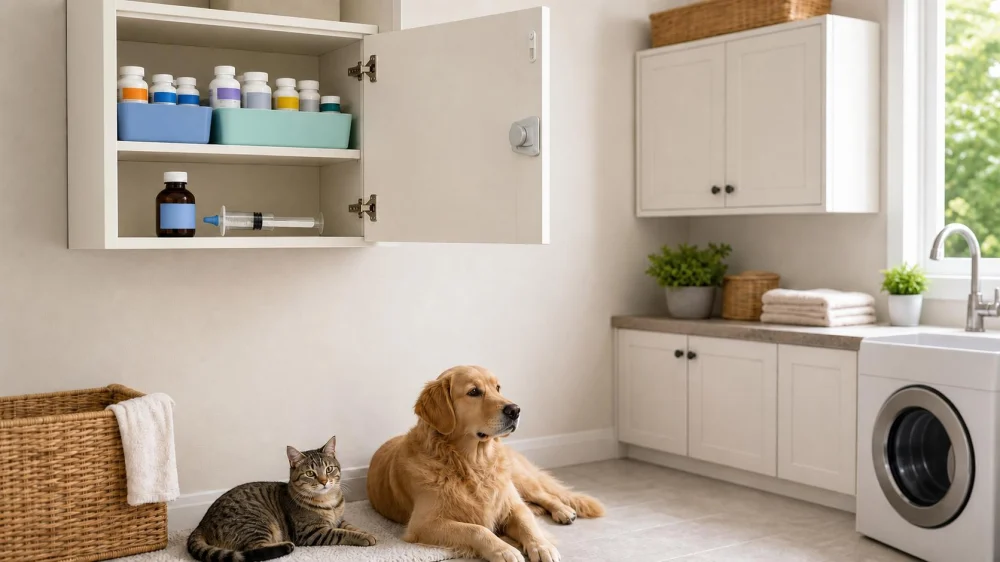
- Inside a latched or locked cabinet or container
- Inaccessible to pets even if they jump, climb, nose doors open, or knock items down
- Out of sight and reach of children
- Dry, clean, and protected from spills
- Away from food preparation and pet treats
- Away from purses, backpacks, bedside tables, countertops, and open shelves
Consider every animal in the home, not only the patient. A dog may consume a cat's medicine, or one pet may chew a tube and expose another.
Separate pets, people, and dosing tools
Create distinct labeled sections for each pet and a different storage area for human medication. The FDA pet medication storage guide recommends separating animal and human drugs to prevent mix-ups.
Reduce confusion by:
- Using each pet's full name and photo on an outer storage bin without covering the pharmacy label
- Keeping look-alike bottles in different compartments
- Using one dedicated oral syringe per medication when directed
- Never using a kitchen spoon to estimate liquid doses
- Maintaining a current medication list with drug, strength, route, schedule, and prescriber
- Removing discontinued medicine from the active-dosing area while arranging proper disposal
Do not share one pet's prescription with another unless a veterinarian specifically directs it.
Follow temperature and light instructions
“Room temperature,” “refrigerate,” “protect from light,” “do not freeze,” and moisture warnings are product-specific. Follow the dispensing label and ask the clinic or pharmacy when wording is unclear.
- Room-temperature medicine: Avoid hot cars, direct sun, stoves, radiators, and humid bathrooms.
- Refrigerated medicine: Use a secure dedicated bin inside the refrigerator, away from food spills and inaccessible to children.
- Do not freeze: Keep away from freezer vents and cold packs that touch the container directly.
- Light-sensitive medicine: Retain protective packaging.
- Compounded medicine: Follow its specific beyond-use and storage instructions; formulations can differ.
If medicine was left in heat, frozen, spilled, or stored incorrectly, do not guess that appearance proves it is usable. Ask the dispensing professional.
Prevent errors during daily dosing
- Read the label every time, even for a familiar medicine.
- Confirm the pet, drug, strength, amount, route, and time.
- Measure in good light on a clean surface away from other animals.
- Close the container immediately before giving the dose.
- Return it to secure storage before releasing the pet.
- Record the dose in a shared log so another caregiver does not repeat it.
- Clean and dry reusable dosing tools as instructed.
Do not cut, crush, open, or dissolve a tablet or capsule unless the veterinarian or pharmacist instructs you. Modified-release, coated, hazardous, or very small-dose products can require special handling.
The FDA's veterinary medication errors page recommends asking what to do after a missed dose, vomiting, accidental excess, or other dosing problem before it happens.
Transport medication without losing control
Carry medicine in original containers inside a secure closed bag that remains under responsible adult control. Bring enough for the trip plus a modest contingency only when the prescriber approves.
- Keep a copy of the prescription and veterinary contact information.
- Use a temperature-controlled travel container exactly as advised for refrigerated products.
- Prevent direct contact between medicine and ice packs unless instructed.
- Never leave medicine in a parked vehicle.
- Check airline, border, and destination rules before travel.
- Keep sharps in an appropriate container and plan lawful disposal.
Do not put loose tablets in a treat bag, pocket, or unlabeled organizer for convenience.
Handle expired and unwanted medication
Remove expired, stopped, or unwanted medication from active storage, but keep it secure until disposal. Do not give leftovers for a new illness or save an antibiotic “just in case.”
FDA says community drug take-back programs are the preferred solution for many expired or unwanted pet medications. If none is available, follow current FDA disposal guidance and product-specific instructions. Some medicines have special flush-list guidance; do not flush medicine routinely or discard sharps in household trash without approved containment.
Ask the veterinary clinic, pharmacy, or local waste authority about take-back options. Remove or obscure personal information on empty labels only after disposal requirements are met.
What to do after a possible exposure or error
If a pet may have eaten medication, received the wrong product, or received too much:
- Move all remaining medicine away from animals and children.
- Do not induce vomiting or give food, milk, charcoal, or another remedy unless a professional directs it.
- Call the veterinarian, emergency animal hospital, or an animal poison control center immediately.
- Have the container, strength, estimated amount, time, pet species, age, weight, and symptoms ready.
- Follow transport instructions and bring the original packaging.
For a human who swallowed or was exposed to animal medicine, call the appropriate healthcare provider or Poison Control. Needlestick, skin, eye, and inhalation exposures can require immediate care.
Do not wait for symptoms after a potentially dangerous exposure. FDA also accepts reports of animal drug side effects, product problems, and medication errors through its official reporting channels.
Frequently asked questions
Is a childproof cap safe from pets?
No. FDA notes that pets can chew through many containers. Use secure storage beyond the package closure.
Can pet medicine stay in a weekly pill organizer?
Ask the veterinarian or pharmacist. Original containers preserve identification and protection, and some products require specific packaging.
Should liquid medicine be refrigerated?
Only when its label or dispensing professional says so. Storage differs by product and formulation.
Can I use medicine left from another pet?
No unless a veterinarian who knows the current patient specifically prescribes or directs it. Species, weight, diagnosis, dose, and interactions differ.
What if I miss a dose?
Follow the product-specific instructions or call the clinic. Do not double the next dose unless the prescriber explicitly tells you to.
Conclusion and storage checklist
Keep medicines in original labeled containers, separate each pet and all human drugs, lock them beyond reach, follow temperature instructions, use dedicated dosing tools, and record every dose. Plan take-back disposal and save emergency contacts. After a mix-up or exposure, call immediately with the packaging in hand rather than trying a home remedy.




 The Seattle Barkery4.0 (156 reviews)
 Loving Care Veterinary Hospital4.0 (116 reviews)
 Boston Veterinary Clinic4.0 (80 reviews)
 Jazzy Pet Shop0.0 (0 reviews)
 Omar's Exotic Birds4.0 (594 reviews)
 Forked River Animal Hospital4.0 (490 reviews)
 Why Is My Kitten’s Meow So Squeaky? Causes and Meaning Explained
 Understanding Kitten Neutering and Spaying: Best Age and Benefits
 The Best Pet Insurance for Purebred Cats with Genetic Conditions
 The Best Litter Box Setup for Multiple Cats in One Home
 How to Keep Your Kitten from Chewing on Shoes
 Best Pet Insurance Providers of 2024: Comparing Plans and Coverage