
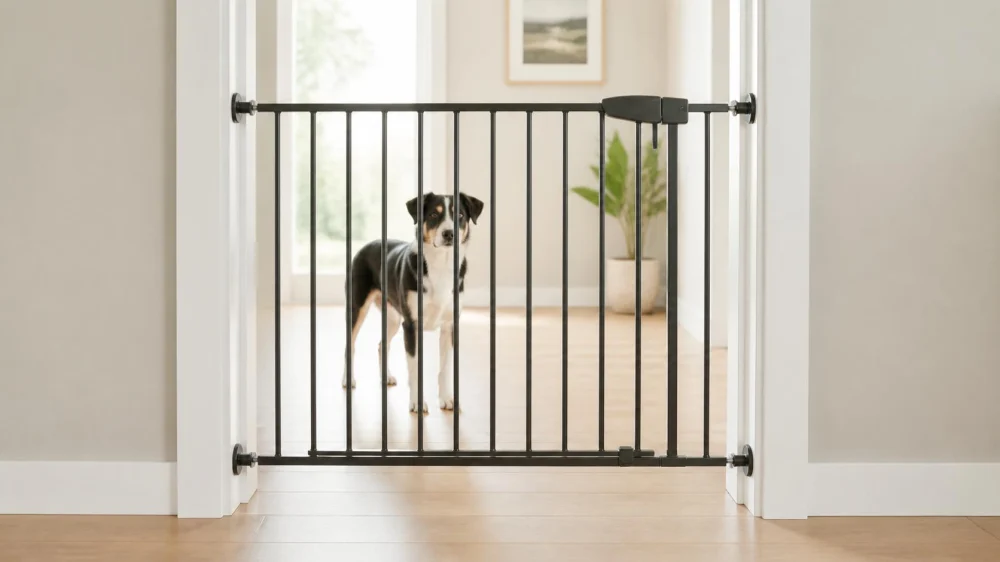
Pet Gate Safety: Fit the Opening, Pet, and Location
On this page
Quick answer
Choose a pet gate by the exact opening width, mounting surface, location, pet size, age, mobility, jumping, climbing, and chewing behaviour. Use only a gate whose manufacturer permits that location. At the top of stairs or another fall hazard, a properly installed hardware-mounted product is generally the safer category; pressure-mounted gates can shift and often are not approved there. Check the manual and never improvise extensions or mounting.
A gate is a management tool, not unsupervised proof against escape. Stop using it if the pet climbs, jumps, squeezes through, becomes trapped, chews parts, or shows intense distress.

Match the gate to the pet
- Measure shoulder and head width, not just weight.
- Consider whether the pet can jump or climb the gate height.
- Avoid openings that could trap a head, limb, collar, or paw.
- Choose chew-resistant materials for pets that mouth barriers.
- Consider senior pets, puppies, kittens, and animals with limited vision or mobility.
Vertical bars may reduce climbing opportunities compared with mesh or horizontal rails, but spacing and product design still matter.

Whole Pet Veterinary Center
WestfordMiddlesex CountyMassachusetts
270 Littleton Rd Suite #20, Westford, MA 01886, USA
Choose pressure or hardware mounting
Pressure-mounted gates press against walls or doorframes and can work in approved level locations without drilling. Hardware-mounted gates attach to suitable structure and are often required by the manufacturer for stairs or stronger containment.
Check baseboards, uneven trim, hollow walls, banisters, tile, and angled openings before buying. Use only manufacturer-approved cups, anchors, banister kits, and extensions for that model.
Check gaps, latches, and footholds
- Measure the full opening at top, middle, and bottom.
- Install the gate level and in the specified orientation.
- Verify every mounting point and indicator.
- Test the latch and auto-close feature if provided.
- Check gaps beside, below, and above the gate.
- Remove nearby furniture the pet could use as a launch point.
Keep collars, leashes, toys, cords, bowls, and fabrics away from the bars and hinges where they can snag.
Introduce the barrier calmly
Let the pet see and sniff the installed gate while supervised. Reward calm behaviour away from the barrier and practice short separations within the pet's comfort. Do not push the animal against it, tease through it, or use the gate as punishment.
If the pet panics, bites the gate, redirects aggression, or repeatedly attempts escape, stop and seek guidance from a veterinarian or qualified behaviour professional.
Inspect it every day
Before relying on the gate, push and pull as directed, test the latch, and check mounts, cups, screws, hinges, extensions, welds, mesh, and floor contact. Recheck after cleaning, moving furniture, a collision, or a determined escape attempt.
Keep the route around the gate dry and well lit. Teach people to close it fully and never step over a tall gate while carrying a pet, child, or heavy object.
Important limitations
This is general U.S. pet-home safety information. Gate designs, age ratings, locations, building surfaces, and pet needs vary. Follow the exact manufacturer instructions and recall notices. A veterinarian or qualified behaviour professional should address health, anxiety, or escape behaviour.
Evidence notes
The plan treats containment as a fit-and-force problem: correct dimensions, approved mounting, limited gaps, reliable latching, pet-specific behaviour, and frequent inspection all matter. Location risk changes the required mounting approach.
FAQ
Can I use a pressure gate at the top of stairs?
Use only a product specifically approved and installed for that location; hardware-mounted gates are generally the appropriate category.
How tall should the gate be?
Follow product guidance for the pet's size and jumping or climbing ability.
Can I add a homemade extension?
No. Use only extensions approved for that exact model.
What if my dog chews the gate?
Stop unsupervised use and choose a safer management and behaviour plan.
Should the gate swing over stairs?
Follow the manufacturer; gates near stairs generally should not open over the drop.
Next steps
Measure the opening in three places, assess the pet's behaviour, choose a location-approved product, install it exactly as directed, supervise the introduction, and add the latch and mounts to a daily check.





 Cave Creek Equine Sports Medicine & Surgery4.0 (68 reviews)
 All About Pets4.0 (92 reviews)
 RTC Pet Products Co0.0 (0 reviews)
 The Mexican Pet Shop5.0 (2 reviews)
 Partner’s Place5.0 (3 reviews)
 Charlestown Pet Clinic3.0 (56 reviews)
 The Best Diet for a Pet Parrot: Seeds, Pellets, and Fresh Foods
 The Best Way to Bathe a Kitten for the First Time – Safe and Stress-Free Tips
 Why Is My Dog Drinking So Much Water? Potential Health Issues and What to Do
 A Guide to Cat Behavior: What Does It Mean When Your Cat Winks?
 How to Build a 'Catio' (Cat Patio) for Safe Outdoor Time
 How to Keep Your Cat Entertained While You're at Work