
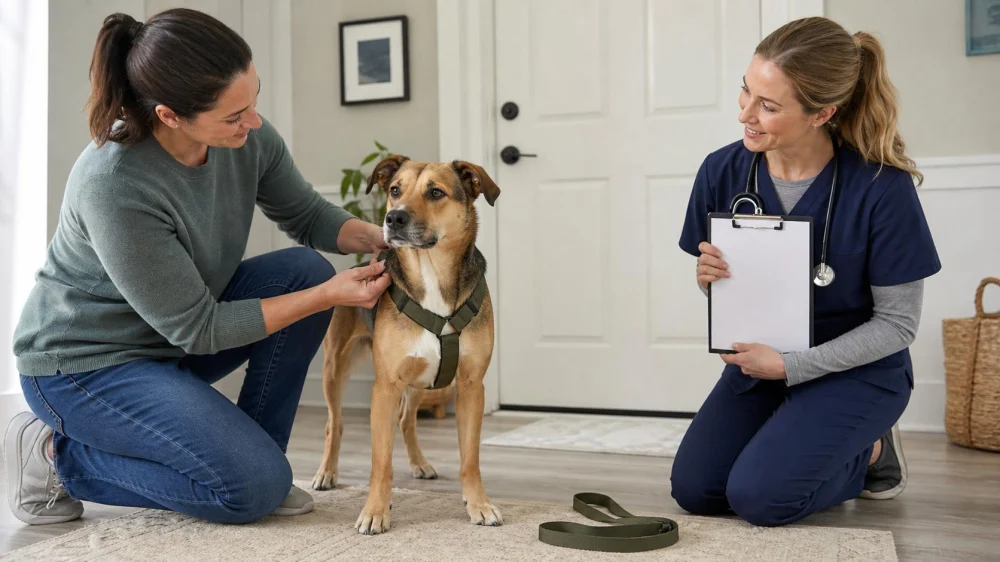
Pet Harness Fit: Check Straps, Movement, and Escape Risk
On this page
Quick answer
Choose a harness made for the pet's species, body shape, size, and intended activity. With the pet calm indoors, identify each strap, adjust it according to the product instructions, check breathing and limb movement, and attach the leash to the correct point. Supervise a short test and stop if the pet backs out, freezes, coughs, rubs, or shows distress.

Why harness fit changes during movement
A harness can look centred while a pet stands but rotate, tighten, loosen, or shift toward the throat when the animal walks, pulls, backs up, sits, or lowers the head. Coat thickness, weight change, wet fabric, growth, grooming, posture, and product stretch alter fit. Different harnesses are designed for walking, travel, sport, or medical support and are not interchangeable.
This guide is for United States pet owners checking an ordinary walking harness for a dog or a harness-trained cat. It is not veterinary, behaviour, restraint, mobility-device, car-crash, climbing, or service-animal-equipment advice. Product instructions and the individual animal's health and behaviour control the setup.

River and Reef Aquatics
StatesvilleIredell CountyNorth Carolina
228 Signal Hill Dr, Statesville, NC 28625, USA
Practical checklist
- Pet species, age, weight, chest and neck measurements, body shape, coat, growth, medical or mobility needs, and escape history.
- Harness model, intended use, size range, strap map, adjustment points, leash attachment, care instructions, and replacement guidance.
- Webbing, mesh, padding, seams, buckles, adjusters, rings, clips, elastic, reflective material, and edges for wear or damage.
- Position relative to throat, shoulders, front legs, sternum, ribs, spine, armpits, skin folds, surgical sites, and sensitive areas.
- Breathing, walking, sitting, lying, turning, head lowering, stairs, pulling, backing up, and normal range without rubbing or restriction.
- Correct leash, clip closure, backup strategy if recommended, door and gate control, identification, and a low-distraction indoor test area.
- Redness, hair loss, sores, coughing, gagging, limping, weakness, fear, freezing, frantic escape attempts, or changed behaviour.
Step-by-step plan
- Measure the pet as the harness maker directs and select the intended use and size; do not choose by breed label or appearance alone.
- Inspect every component before fitting and compare the physical harness with the instruction diagram so straps are not twisted or reversed.
- Introduce the harness gradually with the pet calm. Avoid forcing the head or limbs through openings when the design or animal response is uncertain.
- Adjust straps in the stated order and check the product's fit method at the neck, chest, and behind the legs without compressing the throat.
- Observe slow indoor walking, sitting, turning, head lowering, and gentle backing while controlling doors and escape routes.
- Attach the leash to the designated point, verify the clip, and test light directional pressure indoors. Stop if the harness rotates, gaps, tightens, or the pet begins to escape.
- Recheck after several minutes and after coat, weight, growth, laundering, or activity changes. Clean, dry, and store the harness according to instructions.
Note the product and size, pet measurements, strap positions, adjustment marks if the maker permits, date, activity, coat condition, movement observations, rubbing areas, backing response, hardware condition, cleaning, and replacement. Photograph fit from several calm standing angles without delaying care for symptoms.
Limits and important notes
Do not leave an ordinary harness on an unsupervised pet unless veterinary or product-specific guidance explicitly supports it. A walking harness is not automatically crash-tested, lift-rated, bite-resistant, escape-proof, or suitable for tethering. Adding knots, pins, clips, or altered stitching can create pressure points and unpredictable failure.
Remove the harness if safe and contact a veterinarian for breathing difficulty, coughing, gagging, collapse, weakness, significant pain, limping, skin wounds, swelling, or symptoms after pressure or entanglement. Seek qualified behaviour help for intense fear or repeated escape attempts. Replace damaged hardware before another outing.
Frequently asked questions
How tight should a pet harness be?
Use the product's stated fit check. It should remain secure without compressing the throat, restricting movement, or rubbing sensitive areas.
Why can my pet back out of the harness?
Body shape, loose or shifted straps, wrong size or design, coat, posture, and escape behaviour can create gaps during backward movement.
Can a harness stay on all day?
Continuous wear can increase rubbing, snagging, heat, and unsupervised risks. Follow veterinary and product-specific guidance.
Is a no-pull harness right for every pet?
No. Design, fit, gait, training plan, medical condition, and handler technique should be considered with qualified guidance.
When should I replace the harness?
Replace it for damaged webbing, stitching, buckles, rings, lost adjustment, persistent odour or contamination, or when size and use no longer match.
Sources and evidence
Use the harness manufacturer's current size, fit, use, cleaning, and replacement instructions; the pet's veterinarian for medical or mobility concerns; and a qualified force-free behaviour professional when fear or escape behaviour affects fitting. Product-specific directions override generic finger or measurement rules.
Conclusion and next steps
Match the harness to the individual pet and activity, inspect it, adjust in the stated order, and test calm movement and gentle backward pressure indoors. Recheck after changes in coat, size, laundering, or behaviour. A secure fit protects movement and breathing while reducing—not guaranteeing against—escape.





 DogVenture New Britain5.0 (13 reviews)
 Native Colors Exotics / The Serama Club of Wisconsin5.0 (2 reviews)
 Chippens Hill Veterinary Hospital4.0 (320 reviews)
 Olimpossport5.0 (1 reviews)
 ESA Pet Today5.0 (2 reviews)
 Wrightwoods Littlest Pet Shop4.0 (21 reviews)
 A Complete Guide to Feline Heart Disease: Symptoms and Life Expectancy
 How to Introduce a New Puppy to Your Resident Cat: A Step-by-Step Guide
 Pet Harness Fit: Check Straps, Movement, and Escape Risk
 Pet Leash Check: Webbing, Clips, Length, Grip, and Storage
 Why Is My Kitten's Fur Changing Texture? Causes and Solutions for Pet Owners
 Why Is My Kitten's Paw Pad Cracked? Understanding the Causes and Treatment