
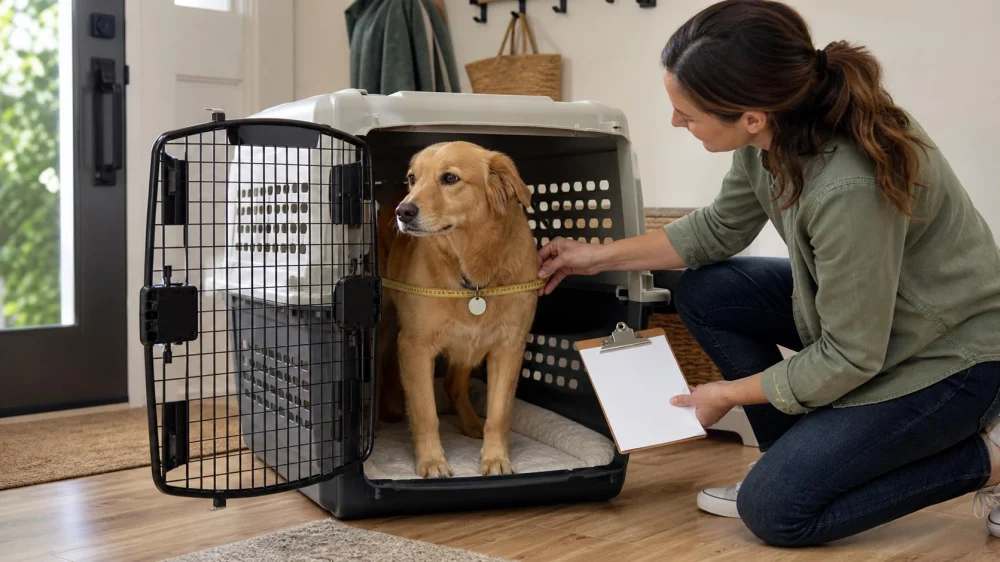
Pet Travel Crate Setup: Fit, Ventilation, and Placement
Quick answer
Choose a sturdy travel crate that lets your pet stand naturally, turn around, sit, and lie in a normal position. Introduce it gradually at home, inspect every latch and vent, and secure it exactly as the crate and vehicle manufacturers direct. Keep airflow clear, monitor temperature and stress, and confirm airline rules separately.

Measure your pet before buying
A label such as “medium” is only a starting point. Measure the individual animal while standing in a relaxed posture:
- Measure from the tip of the nose to the base of the tail, not to the tail tip.
- Measure from the floor to the top of the head or erect ears, whichever is higher.
- Measure across the widest part of the body.
- Weigh the pet and compare the result with the crate maker’s stated limit.
The interior should allow normal posture and a comfortable turn. A crate that is too small restricts movement and may worsen stress or overheating. A crate that is unnecessarily large may let the pet slide or be thrown against the interior during sudden movement. Follow the manufacturer’s sizing method because required clearances and construction differ.

Puppies For Less - Sky Pointe Las Vegas
6440 Sky Pointe Dr Suite 150, Las Vegas, NV 89131, USA
Choose a suitable travel crate
Match the crate to the animal, trip, and carrier rules. A hard-sided crate can offer structure and is often easier to clean. A soft carrier may be practical for a small, calm pet when its maker approves the intended use. It must hold its shape, close securely, and provide ventilation without giving the pet an escape opening.
- Check the door, hinges, seams, handle, and locking points.
- Choose non-toxic, easy-to-clean materials.
- Use an absorbent, flat liner that does not bunch around the pet.
- Avoid loose toys, heavy bowls, or hard objects that could become projectiles.
- Never rely on a damaged, bent, chewed, or improvised latch.
Crashworthiness is not guaranteed merely because a product is called a travel crate. Look for clear test information relevant to the product’s size and installation, then use every required anchor or strap. Marketing language is not a substitute for installation instructions.
Build a calm crate routine
Do not make departure day the pet’s first crate experience. Leave the crate open in a quiet room. Add familiar bedding if the pet will not chew or swallow it. Offer treats or meals near the entrance, then inside, without forcing the animal. Progress from brief voluntary entries to short closed-door sessions while you remain nearby.
Next, practice carrying the crate safely or sitting in a stationary vehicle. Follow with short drives and calm returns home. If the pet pants, drools, vocalizes, scratches, freezes, urinates, vomits, or refuses high-value food, shorten the session. Ask a veterinarian or qualified behavior professional for a plan when fear is intense. Do not give sedatives or human medicine unless the veterinarian has prescribed and explained it for this pet and trip.
Inspect the crate before every trip
A quick inspection catches changes that storage can hide. Run a hand over interior surfaces and remove sharp edges, broken wire, exposed fasteners, or chewed plastic. Confirm that the door closes fully and every latch engages. Check that ventilation holes are open and the floor and liner are dry.
Attach identification where it will remain visible: your name, mobile number, destination contact, and an alternate contact. Keep a recent pet photo, vaccination and medical information, medication instructions, and microchip number with your travel documents. Do not display more personal information than the trip requires.
Place and secure it in the vehicle
Read both manuals before installation. Put the crate in a position the vehicle and crate manufacturers approve, with a stable base and no interference from doors, controls, or the driver. Use the specified seat belt path, anchors, straps, or cargo attachments. Pull on the installed crate before departure; it should not tip or travel across the cabin during ordinary turns and braking.
Do not place a pet carrier on a lap, stack luggage on it, or leave it loose on a seat. Keep it away from an active front airbag unless the vehicle maker explicitly provides a safe configuration. Cargo areas differ: some are climate-controlled passenger space, while isolated trunks and pickup beds can expose pets to extreme heat, cold, exhaust, weather, and impact. Never improvise placement where you cannot monitor the pet.
Protect ventilation and temperature
Keep every vent clear of luggage, blankets, seat backs, and vehicle trim. Sun can heat one side of a crate even when the cabin feels comfortable. Direct air gently through the occupied area without blasting the pet’s face. Check the animal at every safe stop and offer water according to its needs and veterinary advice.
Never leave a pet in a parked vehicle. Interior temperature can become dangerous quickly, and cracked windows or shade do not make the situation reliably safe. Plan stops so a responsible person stays with the animal or use pet-friendly facilities. In cold weather, protect the pet from drafts and prolonged exposure without covering vents.
Pre-trip checklist
- Pet can stand, turn, sit, and lie normally inside.
- Door, latches, shell, seams, and handle are undamaged.
- Crate is installed using the correct instructions and hardware.
- Vent openings remain clear on all required sides.
- Liner is flat, dry, absorbent, and safe if chewed.
- ID and destination contacts are attached; microchip contacts are current.
- Leash or harness is ready for transfer but cannot tangle inside the crate.
- Water, food, medicine, cleanup supplies, and veterinary records are packed.
- Route includes safe breaks and an emergency veterinary clinic.
- Weather, road, lodging, border, and carrier requirements are confirmed.
Air travel needs separate planning
An everyday car carrier may not meet airline requirements. Contact the operating airline well before travel and confirm current crate dimensions, construction, ventilation, door hardware, labels, water containers, check-in times, seasonal restrictions, and breed or health policies. A codeshare flight may involve more than one carrier.
For international or interstate travel, official health certificates, vaccination records, identification, import permits, and examination timelines may apply. Check the destination authority and the USDA Animal and Plant Health Inspection Service guidance, then ask an accredited veterinarian what must be completed. Rules can change, so save written confirmation near the departure date.
Know when to stop and get help
Stop in a safe place and assess the pet if you notice frantic escape attempts, collapse, weakness, repeated vomiting, disorientation, very pale or blue gums, noisy or difficult breathing, or panting that seems excessive for the conditions. Move the animal away from heat or another obvious hazard without risking traffic injury.
Breathing trouble, collapse, seizures, suspected heatstroke, and severe injury are emergencies. Call the nearest veterinarian or emergency hospital while traveling there. Cooling an overheated pet requires prompt veterinary guidance; avoid ice-water immersion unless a veterinarian specifically directs it.
Limitations and special cases
This guide gives general preparation steps, not a guarantee of crash protection and not individualized medical advice. Puppies and kittens, senior animals, flat-faced breeds, pets with heart or respiratory disease, brachycephalic pets, pregnant animals, and pets recovering from surgery may need different limits or may not be fit to travel.
Species needs differ. Birds, reptiles, rabbits, and small mammals require specialized temperature, ventilation, handling, and enclosure advice. Ask an experienced veterinarian before the trip. When a product manual, airline rule, government requirement, or veterinary instruction is stricter than this overview, follow the stricter applicable direction.
Sources and evidence
Use primary and expert sources for final decisions: your vehicle and crate manufacturer manuals for installation; the American Veterinary Medical Association’s pet travel guidance for planning and health; USDA APHIS Pet Travel for United States export and import steps; the airline’s current live-animal policy for flight-specific requirements; and your veterinarian for fitness to travel, medication, anxiety, and emergency advice.
Frequently asked questions
Should my pet wear a collar inside the crate?
Anything worn inside can snag. Ask the crate maker and your veterinarian about the safest arrangement for your pet. Keep identification on the crate and have a properly fitted leash or harness ready before opening the door in a secured area.
Can I cover the crate to reduce stress?
A partial cover can help some animals, but it must not obstruct required vents or trap heat. Monitor temperature and breathing, and remove it if the pet becomes warmer or more distressed.
Can two pets share one travel crate?
Separate crates are usually easier to size, secure, and monitor, and airlines commonly require individual arrangements. Never force unfamiliar or stressed animals together. Ask the carrier and veterinarian about young littermates or another special case.
How often should we stop on a road trip?
There is no single interval for every animal. Age, health, medication, weather, trip length, and house-training matter. Ask your veterinarian and build in more time than you expect to need. Open the crate only in a secure, enclosed area or with a controlled leash transfer.
Is a harness enough instead of a crate?
Restraint options vary by pet and vehicle. Use only a product intended for the animal’s size and the exact travel use, install it as directed, and review credible test information. Do not connect a vehicle belt to a neck collar.
Conclusion
A successful crate setup begins before the engine starts. Measure the pet, choose a sound enclosure, create positive practice sessions, and inspect and secure the crate according to its instructions. Keep airflow open, prevent temperature exposure, carry identification and health information, and watch the pet throughout the trip. For flights, medical concerns, or unusual species, confirm the specialized rules early.





 Scales 'N Tails North Las Vegas4.0 (475 reviews)
 Petco4.0 (1116 reviews)
 Somis Veterinary Hospital4.0 (206 reviews)
 Mountainview Small Animal Hospital4.0 (337 reviews)
 City Island Aquarium Tropical Fish Sales5.0 (20 reviews)
 Pet Shop3.0 (234 reviews)
 Pet Bowl Cleaning: A Daily Routine for Food and Water
 The Top 10 Most Independent Kitten Breeds: Find the Perfect Feline Companion
 Best Dog Breeds for Seniors Seeking Loyal Companionship
 The Best Diet for a Persian Kitten's Flat Face: Expert Tips for Optimal Health
 The Best Diet for a Cornish Rex Kitten's Curly Coat
 How to Stop Your Kitten from Eating Too Fast