
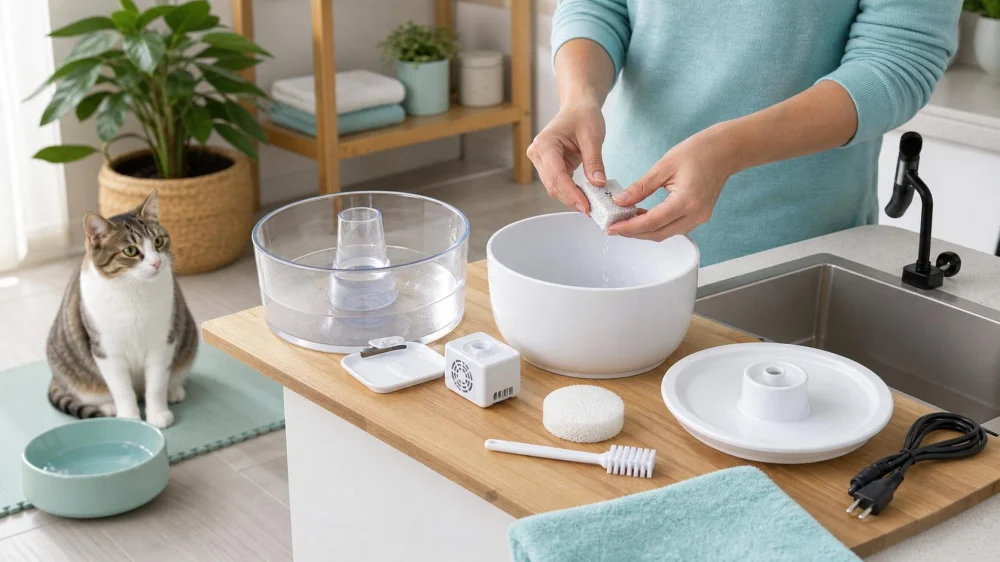
Pet Water Fountain Care: Clean, Filter, and Check the Cord
On this page
Quick answer
Place a pet water fountain on a stable, washable surface near an appropriate outlet, route the cord so it cannot be chewed or tripped over, and fill it with water suitable for your pet. Check level, flow, odor, debris, and cord condition daily. Unplug before disassembly, clean every removable part by the manufacturer’s method, replace filters on schedule, and never run the pump dry.
Provide a separate bowl of fresh water while the fountain is being cleaned, unavailable, or rejected by the pet.

New Milford Animal Hospital:
New MilfordWestern Connecticut Planning RegionConnecticut
2 Sega Dr, New Milford, CT 06776, USA
Set up the fountain safely
- Choose a size and height suitable for the species, number, and mobility of pets.
- Use a flat surface that will not be damaged by splashes.
- Keep it away from litter boxes, raw-food areas, heat, and direct sun.
- Leave airflow around the pump housing as the instructions require.
- Use only the supplied or specified power adapter.
- Protect the cord without wrapping it tightly or creating heat.
- Keep the plug and connection dry.
Do not place the fountain where a pet can pull it from a counter or where a spill can reach unrelated electrical devices.

Mike's Pet Store and pet grooming
Los AngelesLos Angeles CountyCalifornia
1224 Florence Ave, Los Angeles, CA 90001, USA
Daily checks
- Confirm the water level stays above the pump’s minimum mark.
- Look for hair, food, slime, insects, or foreign material.
- Listen for new rattling, grinding, humming, or silence.
- Check that water flows as designed without spraying the floor.
- Smell for unusual or stagnant odor.
- Inspect the cord and plug from a dry position.
- Wash and refill according to the product and household schedule.
Adding water is not the same as cleaning. Minerals, biofilm, and debris can collect below the visible basin.
Cleaning routine
Unplug with dry hands before moving or opening the fountain. Disassemble only the parts shown in the manual and note their order. Wash bowls, towers, lids, seals, and channels with the approved soap, brush, and temperature. Rinse thoroughly so cleaner does not remain.
Use separate pet-dish tools and clean the surrounding mat and floor. Do not mix cleaning products or use bleach, vinegar, descaler, or dishwasher heat unless the manufacturer specifically permits it for each part.
Filter and pump care
Filters have a specific orientation, rinsing step, and replacement interval. A filter can look clean while its capacity has declined. Keep the product name or model and replacement schedule with pet-care records.
Some pumps have a removable cover and impeller that require gentle cleaning; others should not be opened by the user. Follow the manual exactly. Do not lubricate, force, or power the pump outside the assembled water system.
Cord and electrical limits
Stop use for chewing, cuts, exposed conductors, melted areas, a hot adapter, sparks, smoke, burning odor, shock sensation, or repeated outlet protection trips. Unplug only when safe and replace the approved component or entire unit; do not tape a damaged cord.
Do not use a household extension cord, place connections on a wet floor, or reach through spilled water to unplug. Isolate the area and obtain electrical help if water and energized equipment may be in contact.
When to stop using it
- Cracked or leaking bowl or housing
- Persistent slime, odor, or deposits after approved cleaning
- Broken filter seat, seal, or lid
- Pump noise, overheating, intermittent flow, or dry running
- Damaged cord, plug, or adapter
- Sharp edges or loose small parts
- A pet that refuses water, tips the unit, or chews components
Ask a veterinarian promptly about reduced drinking, increased drinking, vomiting, lethargy, or other health changes rather than assuming the fountain is the only cause.
Frequently asked questions
How often should I clean the fountain?
Follow the manufacturer and adjust for pets, water, environment, and visible buildup. Daily observation remains important.
Can I use any replacement filter?
Use the compatible type specified for the model.
Why is the pump noisy?
Low water, debris, assembly, wear, or damage may contribute. Unplug and follow troubleshooting instructions.
Should I leave a bowl beside it?
A backup fresh-water source is helpful during cleaning, outages, travel, or transition.
Can cats play with the cord?
No. Route and protect it, and stop use if chewing occurs.
Sources and evidence notes
This guide applies pet-dish hygiene, pump-water-level, small-appliance electrical, cord, and cleaning-product compatibility principles. Exact intervals and approved methods vary by fountain, filter, pump, water quality, pet, and household.
Follow the manufacturer’s manual and veterinarian guidance for your pet’s hydration and health needs.
Conclusion and next steps
Create a simple fountain schedule: daily water and cord check, regular full disassembly, filter replacement, and pump care exactly as instructed. Keep the plug dry, never run the pump without enough water, and maintain a clean backup bowl. Retire leaking, electrically damaged, or uncleanable equipment instead of improvising a repair around water.




 Great Brook Veterinary Clinic4.0 (212 reviews)
 Ashton Animal Hospital4.0 (326 reviews)
 Petland Pickerington4.0 (790 reviews)
 PetVet Vaccination Clinic0.0 (0 reviews)
 Edgewater Animal Hospital4.0 (232 reviews)
 Simi Valley Animal Hospital4.0 (40 reviews)
 How to Create a Safe Outdoor Enclosure for Your Cat – Tips and Ideas
 The Best Pet-Safe Mosquito Repellent for Outdoor Kittens
 How to Help a Kitten with a Broken Whisker: Expert Tips and Care
 The Best Pet Cameras with Laser Toys for Cats
 How to Tell if Your Kitten is a Boy or Girl Accurately
 Best Wet Food for Kittens Needing Extra Calories – Top Brands & Tips