
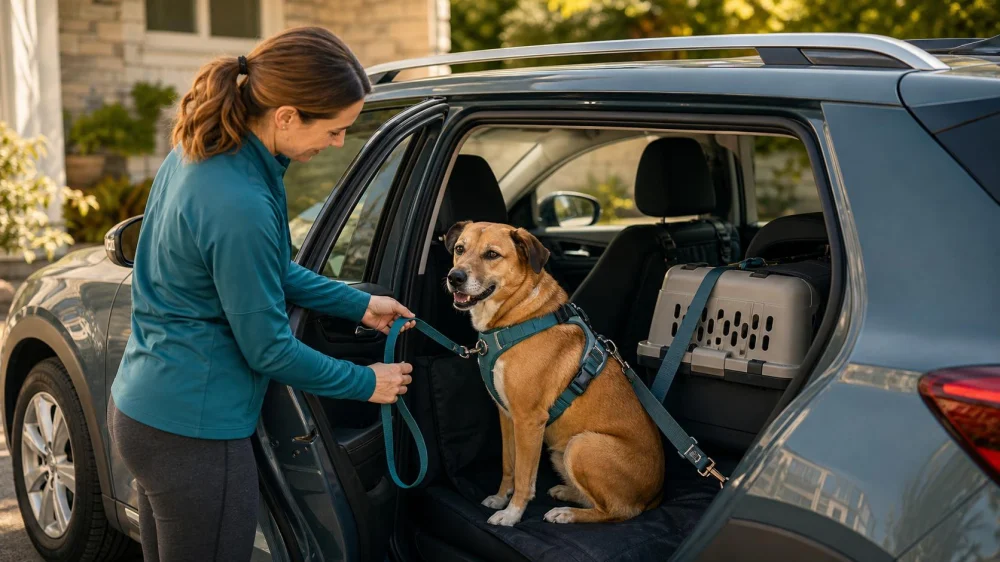
Pet Car Restraint Check Before a Routine Drive
Table of contents
Quick answer
Before each drive, use a correctly sized travel carrier or pet travel harness in the back seat and install it exactly as the restraint and vehicle makers direct. Check fabric, stitching, buckles, latches, anchor straps, and fit. Secure a carrier so it cannot slide or shift. Keep a leash attached during transfers, close doors before releasing it, and never let the pet roam or ride with its head outside.

Hopewell Veterinary Group Inc
HopewellMercer CountyNew Jersey
230 Pennington - Hopewell Rd, Hopewell, NJ 08525, USA
Choose a carrier or travel harness
The right restraint depends on species, size, body shape, behavior, health, vehicle, and product design. Small pets and cats often travel in a well-ventilated carrier with enough room to stand, sit, lie down, and turn around. Some dogs use a vehicle travel harness designed to connect to an approved belt or anchor system.
A walking harness, collar, tote, laundry basket, or soft bed is not automatically a vehicle restraint. Read the product's intended use, size range, installation method, and replacement guidance. Check the vehicle manual before attaching anything to a seat belt, head restraint, cargo hook, or child-seat anchor.

Inspect every connection point
Lay out the restraint in good light and follow the load path from the pet to the vehicle. Look for:
- frayed webbing, torn fabric, stretched elastic, or chewed areas;
- loose stitching, bent hardware, cracked plastic, or rust;
- a buckle or carrier door that does not close positively;
- missing clips, panels, screws, or manufacturer-supplied parts; and
- twists that prevent straps from lying flat.
Replace or contact the manufacturer about a questionable part instead of tying a knot, adding a household carabiner, or combining pieces from different products. Follow any replacement instruction after a collision, hard impact, or significant chewing.
Check fit before entering the car
Put the harness on in a calm indoor or enclosed area. Confirm the product's fit points and adjustment rule, then watch the pet sit, stand, and lie down. Straps should not cross the throat, restrict normal breathing, rub under the limbs, or allow the pet to back out.
For a carrier, check interior space, ventilation openings, door alignment, and bedding that cannot bunch around the face. Remove a dangling leash inside the closed carrier if the product or veterinarian says it creates an entanglement risk, but keep a leash ready for the transfer.
Secure the pet in the back seat
Park, turn off the engine, and open only the controlled entry door. Install the empty carrier or attachment as directed, then load the pet. The U.S. Centers for Disease Control and Prevention recommends keeping a seat-riding pet in the back seat with a harness attached to the seat buckle; it also advises securing crates so they do not slide or shift when the car stops.
Use only the connection points named by the restraint and vehicle manufacturers. Adjust tether length to permit the position the product intends without allowing the pet to reach the driver, cross the seat, enter the footwell, or become tangled. A pet should not occupy the driver's lap.
Control doors, windows, and transfers
Attach the walking leash before the restraint is disconnected and before a door opens wide. One adult should control the leash while another handles a carrier or luggage when possible. Use child locks or window locks if a paw could operate a switch.
Do not allow a pet's head or body outside a moving vehicle. Avoid an open truck bed. At the destination, park fully, close other escape routes, check traffic, attach the leash, and then release the vehicle restraint in the order recommended by its maker.
Use a short-drive routine
- Practice approaching and sitting in the stationary vehicle with rewards appropriate for the pet.
- Install the restraint the same way every time.
- Begin with a short, smooth drive and a familiar destination.
- Have another adult observe the pet when practical while the driver watches the road.
- After parking, inspect fit, shifted straps, panting, drooling, vomiting, or distress.
Keep ventilation comfortable and never leave an animal unattended in a parked vehicle. Secure loose bowls, bottles, bags, and other objects so they do not strike the pet during a stop.
Pre-drive restraint checklist
- The carrier or harness is intended for vehicle travel and fits the pet.
- Fabric, stitching, buckles, latches, door, and hardware are undamaged.
- Installation matches both product and vehicle instructions.
- The carrier cannot slide or tip in normal driving and braking.
- The harness lies flat and does not cross the throat.
- The pet remains in the back seat and cannot reach the driver.
- Leash and door control are planned for both transfers.
- Identification, water, medication, and veterinary contact details are ready as needed.
Limits and veterinary cautions
This article provides general pet-travel information, not veterinary or product-engineering advice. No restraint eliminates all collision risk. Installation, fit, condition, crash history, pet anatomy, health, and vehicle design affect performance.
Ask a veterinarian before travel when a pet has breathing, heart, mobility, anxiety, motion-sickness, pain, postoperative, or other medical concerns. Seek urgent veterinary care after a collision or when a pet develops breathing difficulty, collapse, severe distress, uncontrolled bleeding, or another emergency sign—even if no external injury is obvious.
Frequently asked questions
Can I clip the vehicle tether to my pet's collar?
Use only the attachment point specified by the restraint manufacturer. Vehicle force directed through a neck collar can be dangerous; a purpose-designed travel harness typically manages forces across the body.
Where should a carrier go?
Follow the carrier and vehicle instructions. The carrier should be secured so it cannot slide or shift and should not block the driver, controls, exits, or required visibility.
Is a routine five-minute drive too short for a restraint?
No. Roaming can distract the driver or create risk during any sudden stop. Use the same check for routine errands as for a longer trip.
Can two pets share one carrier?
Only when the carrier maker and veterinarian consider it appropriate for those animals. Crowding, conflict, heat, and inadequate movement space can make sharing unsafe.
Veterinary and public-health sources
- CDC: Pet Travel Safety
- American Veterinary Medical Association: Traveling With Your Pet
- The exact restraint and vehicle manuals are the primary installation sources for a specific setup.
Conclusion and next steps
Make the restraint check as routine as finding the keys: inspect, fit, install, control the door, and confirm the pet cannot shift or reach the driver. Practice on a calm short drive before a demanding trip, and replace uncertainty with advice from the product maker or your veterinarian.






 Hollywood Feed5.0 (186 reviews)
 Urban Livestock & Equine Veterinary Services4.0 (81 reviews)
 GSVS Veterinary Emergency Care Toms River4.0 (72 reviews)
 Rena's Pet Supplies4.0 (454 reviews)
 Joes shrimp shack4.0 (196 reviews)
 Petco4.0 (945 reviews)
 Understanding Why Your Cat Is Hiding: Behavioral and Medical Causes
 Why Does My Cat Knead Me? The Surprising Reasons Behind This Behavior Explained
 Why Is My Kitten's Fur Changing Texture? Causes and Solutions for Pet Owners
 The Pros and Cons of Getting a Kitten for Christmas: A Holiday Pet Decision
 Pet Toy Inspection: Clean, Repair, or Retire It
 Why Do Cats Love Catnip? And Is It Safe?