
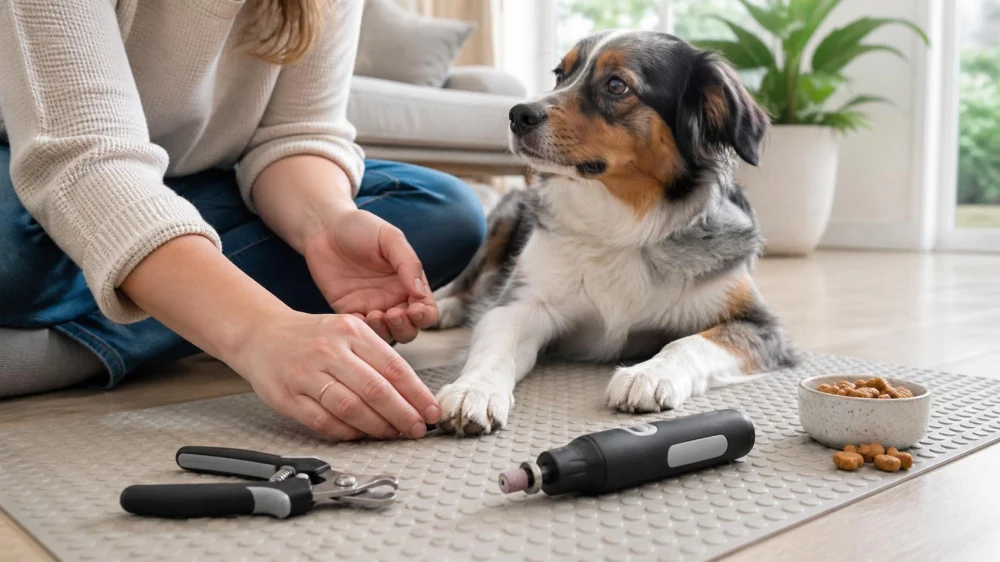
Pet Nail Clippers vs Grinder: Choose by Control and Stress
On this page
Quick answer
Pet nail clippers make a fast single cut but require confident placement and a sharp, correctly sized tool. A grinder removes nail gradually and smooths edges, but noise, vibration, heat, and hair entanglement can stress or injure a pet. Choose the method both pet and handler can use calmly, work in brief steps, and stop before restraint or fear escalates.
This guide is for United States dog and cat caregivers discussing routine nail care. Nail anatomy, color, thickness, disease, mobility, and behavior differ. Ask a veterinarian or experienced pet-care professional to demonstrate the correct method for the individual animal before attempting home trimming.

VCA Olympiad Animal Hospital
Mission ViejoOrange CountyCalifornia
23032 Alicia Pkwy Suite A, Mission Viejo, CA 92692, USA
Clippers and grinders compared
| Feature | Pet nail clippers | Pet nail grinder |
|---|---|---|
| Action | Removes a section in one squeeze | Abrades small amounts with a rotating surface |
| Speed per nail | Fast when placement is clear | Gradual and potentially slower |
| Sensory input | Pressure, click, and cutting sensation | Motor sound, vibration, smell, and warmth |
| Edge | May leave a sharper cut edge | Can round and smooth the edge |
| Primary handling risk | Cut placed too far or nail crushed by a dull tool | Heat buildup, over-grinding, or hair caught in the tool |
Neither tool is universally safer. Safety depends on correct tool size and condition, visibility, pet cooperation, handler skill, stopping criteria, and access to help.
Some caregivers use clippers to remove a small controlled amount and a grinder to smooth the edge. Combining tools adds transitions and sensory exposure, so it is helpful only when the pet is comfortable with both.

Columbus Circle Veterinary Hospital
New YorkNew York CountyNew York
2 Columbus Ave # 3, New York, NY 10023, USA
Match the tool to the pet
Nail size and hardness: a small cat nail, thick dog nail, dewclaw, and damaged nail may need different equipment. Use a pet-specific tool sized for the nail and follow professional instruction.
Nail color: the sensitive living tissue inside the nail, commonly called the quick, may be easier to see in light nails and difficult to judge in dark nails. Tool choice does not remove that uncertainty. A veterinarian or groomer can show a conservative approach.
Sound and vibration: a pet that accepts paw handling may still fear a grinder motor. Another may dislike the sudden clip but tolerate gradual grinding. Observe the animal rather than assuming one species or breed always prefers one tool.
Coat and toe hair: long hair near the paw can become caught in rotating equipment. It must be safely controlled without pulling skin or forcing the foot. Ask a professional if visibility is poor.
Mobility and pain: arthritis, injury, weakness, spinal disease, or recent surgery can make standing or holding a limb uncomfortable. Nail care may need a supported veterinary or grooming plan.
Behavior history: freezing, hiding, panting, struggling, growling, snapping, biting, or escape attempts are information. Do not conceal a bite history from a professional or treat stronger restraint as the solution.
Handler comfort: shaking hands, limited vision, poor grip strength, or uncertainty can increase risk. Professional nail care is a responsible choice, not a failure.
Check the tool before the paw
For clippers:
- use a clean pet nail clipper of appropriate size and design;
- check that blades align, move smoothly, and are not chipped, loose, or dull;
- learn which side of the tool faces the nail according to its instructions;
- keep the handle dry and the work area well lit; and
- replace or service a tool that squeezes or splinters instead of cutting cleanly.
For grinders:
- use a pet-appropriate tool and the recommended abrasive component;
- confirm the guard, cap, speed, battery, and attachments are secure;
- test sound and rotation away from the pet;
- control paw hair, loose clothing, and cords before switching it on;
- use brief contact to limit heat and check the nail frequently; and
- keep rotating parts away from skin, pads, fur, whiskers, ears, and eyes.
For either method, use a nonslip surface, bright light, approved rewards, and a quiet area. Keep other pets and children out of the work space. Ask the veterinarian what first-aid supplies are appropriate and how to use them before a trim, not after bleeding starts.
A gradual handling and sound plan
- Start without a tool. Reward calm presence on a mat or in the usual care position.
- Introduce brief paw touch. Touch a shoulder or leg, then the paw, for a moment the pet tolerates. Release before pulling away becomes a struggle.
- Show the tool at a distance. Pair a brief view with a reward. Do not chase the pet with it.
- Add the sound separately. Click clippers away from the paw or run the grinder at a distance for a moment. Stop while the pet remains comfortable.
- Touch with the inactive tool. If the pet is relaxed, briefly touch the closed clipper or switched-off grinder handle near the paw, then reward.
- Practice positioning. Ask a professional to show a hold that supports the limb without twisting joints or pinning the pet.
- Do one small step. The first successful session may involve one nail or no cutting at all. End before the pet becomes overwhelmed.
- Build gradually. Increase only one variable at a time: duration, proximity, tool sound, paw hold, or number of nails.
Do not punish fear, growling, or pulling away. Growling is a warning that helps prevent a bite. Pause, create distance, and revise the plan with a veterinarian, behavior professional, or skilled groomer.
If food rewards are used, account for allergies, medical diets, and calorie needs. Never put fingers near the mouth of a tense or highly aroused pet.
When to stop and get professional help
Stop the session for escalating fear, repeated escape attempts, trembling, frantic panting, freezing that does not resolve, growling, snapping, biting, pain, sudden limping, or inability to position the paw gently. More people holding the pet down is not a humane default.
Contact a veterinarian for:
- a cracked, split, torn, bleeding, infected-looking, or embedded nail;
- swelling, discharge, odor, redness, or pain around the nail bed;
- a nail curling into or pressing on a paw pad;
- new lameness, toe injury, or a foreign object;
- uncontrolled bleeding or bleeding in a pet with a clotting concern;
- severe fear, aggression, or a need to discuss prescription medication; or
- medical conditions that make positioning or stress risky.
Only a veterinarian should prescribe sedatives or anti-anxiety medication. Do not give human medication, another pet’s prescription, a leftover dose, cannabis, or an unapproved supplement to complete nail care.
A veterinarian, veterinary technician where permitted, groomer, or low-stress handling professional may offer demonstrations, staged visits, cooperative-care plans, or a medical setting. Ask what happens if the pet cannot safely complete all nails in one visit.
Evidence and important limits
This article follows humane handling principles supported by veterinary behavior guidance: use the least stressful effective approach, pair handling with positive experiences, move at the animal’s pace, and avoid forceful restraint. It does not prescribe an exact cut location or grinder duration for every nail.
Nail length is affected by anatomy, activity, surface wear, age, disease, and prior trimming. A clicking sound on a floor is not a complete medical assessment. A professional should evaluate posture, gait, paw condition, and the individual nail before recommending frequency and method.
Frequently asked questions
Is a grinder safer for dark nails?
It removes material gradually, which some handlers find easier to control, but the quick is still present and may be hard to judge. Heat and over-grinding remain risks. Get an individual demonstration.
Do nail clippers hurt pets?
A clean cut through the nonliving nail should not be painful, but pressure from dull tools, cutting the quick, joint twisting, or forceful restraint can hurt. Tool condition and handling matter.
Can I use a human nail clipper?
Use a pet-specific tool suited to the species and nail size unless a veterinarian instructs otherwise. Human tools may not match the nail shape or thickness.
How often should pet nails be trimmed?
There is no universal interval. Growth, wear, anatomy, dewclaws, gait, and health vary. Ask the veterinarian or groomer for a schedule based on the individual pet.
What if my pet allows only one nail?
One calm nail can be meaningful progress if waiting does not create a medical problem. Use brief planned sessions and professional guidance rather than forcing completion.
Should two people hold a pet for nail trimming?
Extra hands are not automatically safer. Forceful restraint can increase fear and injury risk. Ask a professional to design a low-stress handling position and decide whether the care should happen in a veterinary setting.
Next steps
Ask a veterinarian or experienced professional to assess the nails and demonstrate both tool options. Choose the method that gives the handler clear control and the pet the lowest stress. Check equipment, work on a nonslip surface, introduce touch and sound gradually, and keep sessions brief. Stop for pain, bleeding, damaged nails, or escalating fear and arrange professional care.




 Huron Veterinary Hospital4.0 (239 reviews)
 C.F. Exotics5.0 (8 reviews)
 Fur and Feathers Veterinary Care4.0 (323 reviews)
 Medford Pet Clinic3.0 (121 reviews)
 SF Aquatic4.0 (134 reviews)
 Petco4.0 (937 reviews)
 How to Tell if Your Kitten is a Maine Coon Mix
 How to Help a Kitten with a Broken Tail
 Understanding Kitten Vaccination: Side Effects to Watch For
 Understanding Kitten Spay: Laparoscopic vs. Traditional Procedures
 How to Introduce Your Kitten to a New Home Slowly
 How to Stop a Kitten from Bullying an Older Cat