
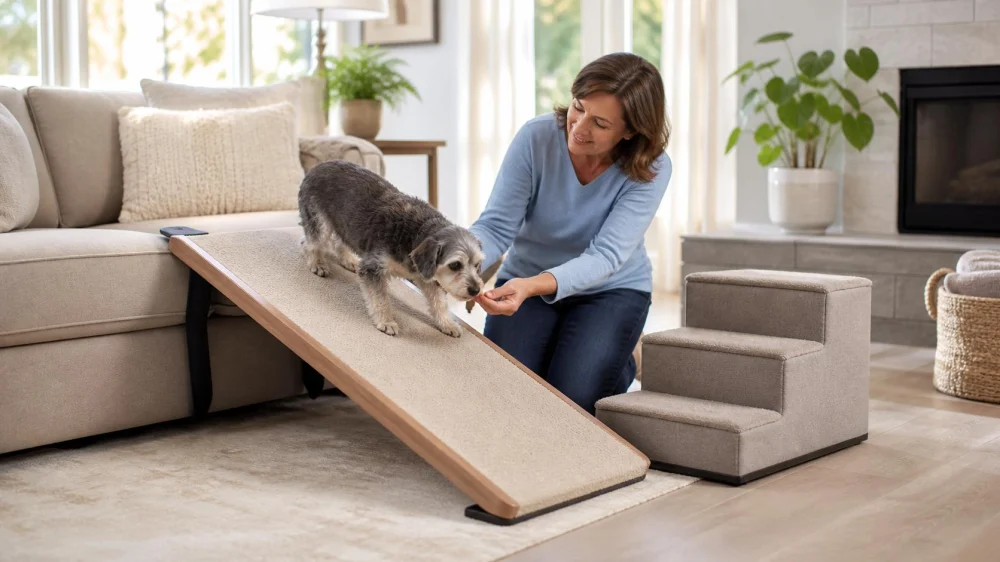
Pet Ramp and Stairs: Check Grip, Support, and Placement
On this page
Quick answer
Choose pet ramps or stairs by the animal’s size, movement, confidence, destination height, and veterinarian guidance. Verify rated capacity, width, slope or step dimensions, side support, surface grip, and attachment. Place the device on stable nonslip flooring with a clear landing, inspect before every use, and teach it slowly with rewards. Never pull, push, or force a fearful or painful pet across.
New difficulty jumping, climbing, standing, or walking can signal a health problem. Contact a veterinarian rather than relying only on new equipment.

Choose ramp or stairs
- Ramp: continuous surface that may suit pets uncomfortable with repeated steps, but needs enough length for a manageable slope.
- Stairs: compact footprint, but riser height, tread depth, and number of steps must fit the pet’s movement.
- Foldable device: easier to store but adds hinges, locks, and pinch points.
- Foam stairs: light and soft but may compress, shift, or lack edge definition.
- Rigid device: stable when correctly supported but heavier to move.
Ask the veterinarian or rehabilitation professional when mobility limits, surgery, pain, neurologic signs, or recovery affect the choice.

Measure the setup
- Measure the vertical height of the bed, sofa, vehicle, or step.
- Measure available floor length and landing space.
- Check the pet’s body width and turning needs.
- Compare dimensions with the manufacturer’s installed configuration.
- Confirm rated capacity exceeds the pet and any expected dynamic load.
- Identify where the top and bottom will be secured.
- Check that humans can still pass safely.
A short ramp to a high surface can be too steep even when it physically reaches.
Inspect before use
- Loose joints, hinges, latches, feet, or fasteners
- Cracks, bending, wobble, or compressed foam
- Worn carpet, slick fabric, wet surface, or loose grip strips
- Sharp edges, splinters, exposed staples, or pinch points
- Gap between the device and destination
- Movement when modest pressure is applied
- Obstacles at the approach and landing
Do not repair a structural failure with household tape or place the device on furniture that can move.
Introduce it gradually
Start flat or at the lowest approved setup when possible. Let the pet investigate, then reward one calm step at a time. Use a harness or leash only as a safety backup without dragging or lifting by the neck. Keep sessions short and end before frustration.
Practice ascent and descent separately. Some pets climb confidently but rush or jump off on the way down. Use barriers or side rails only if designed for the device and accepted by the pet.
Use in the right location
Indoors, keep the base off rugs that slide and away from doors, heaters, cords, and water bowls. At a bed, prevent a gap where paws can catch. At a vehicle, park on level ground away from traffic, set the parking brake, and secure the ramp to the specified anchor before the pet exits.
Outdoor moisture, mud, ice, heat, and uneven ground change grip and stability. Clean and dry the device before use and store it within its temperature and weather limits.
When to stop
Stop for limping, crying, trembling, refusal, rapid breathing unrelated to normal effort, dragging limbs, stumbling, sudden weakness, or repeated jumping off. Move the pet only as veterinary guidance allows and seek care for sudden or severe signs.
Retire the device for structural damage, failed latches, lost grip, unstable placement, or a pet that cannot use it safely despite gradual training.
Frequently asked questions
Is a ramp always easier than stairs?
No. Slope, surface, space, pet size, and health determine usability.
Can I build pet stairs myself?
Only if you can provide reliable structure, dimensions, grip, edges, and attachment. Commercial ratings and veterinary input may be safer.
Should I carry my pet instead?
Ask a veterinarian when lifting may cause pain or injury to the pet or person.
Why does the ramp slide?
Surface, feet, attachment, angle, or damage may be involved. Stop and correct the setup.
Can one device serve several pets?
Only if its dimensions, capacity, grip, and training suit each animal.
Sources and evidence notes
This guide applies stable-access, rated-load, surface-grip, pinch-point, animal-training, and mobility-observation principles. The best device and training plan depend on the individual pet, destination, product, environment, and health.
Use manufacturer instructions and veterinarian or veterinary rehabilitation guidance for pets with pain, weakness, injury, surgery, or mobility changes.
Conclusion and next steps
Measure the destination and floor space, choose a device with suitable geometry and capacity, and secure both ends before training. Inspect grip and structure each time, reward slow controlled use, and keep the landing clear. If the pet hesitates or movement changes, pause and ask the veterinarian instead of making the setup steeper or forcing another attempt.






 Great Brook Veterinary Clinic4.0 (212 reviews)
 Ashton Animal Hospital4.0 (326 reviews)
 Petland Pickerington4.0 (790 reviews)
 PetVet Vaccination Clinic0.0 (0 reviews)
 Edgewater Animal Hospital4.0 (232 reviews)
 Simi Valley Animal Hospital4.0 (40 reviews)
 How to Create a Safe Outdoor Enclosure for Your Cat – Tips and Ideas
 The Best Pet-Safe Mosquito Repellent for Outdoor Kittens
 How to Help a Kitten with a Broken Whisker: Expert Tips and Care
 The Best Pet Cameras with Laser Toys for Cats
 How to Tell if Your Kitten is a Boy or Girl Accurately
 Best Wet Food for Kittens Needing Extra Calories – Top Brands & Tips